A father's love: the Victorian diamond garland necklace from the 1850s
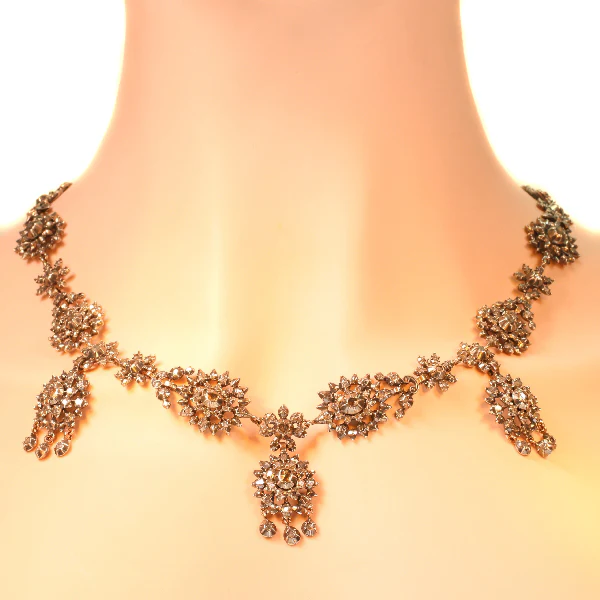
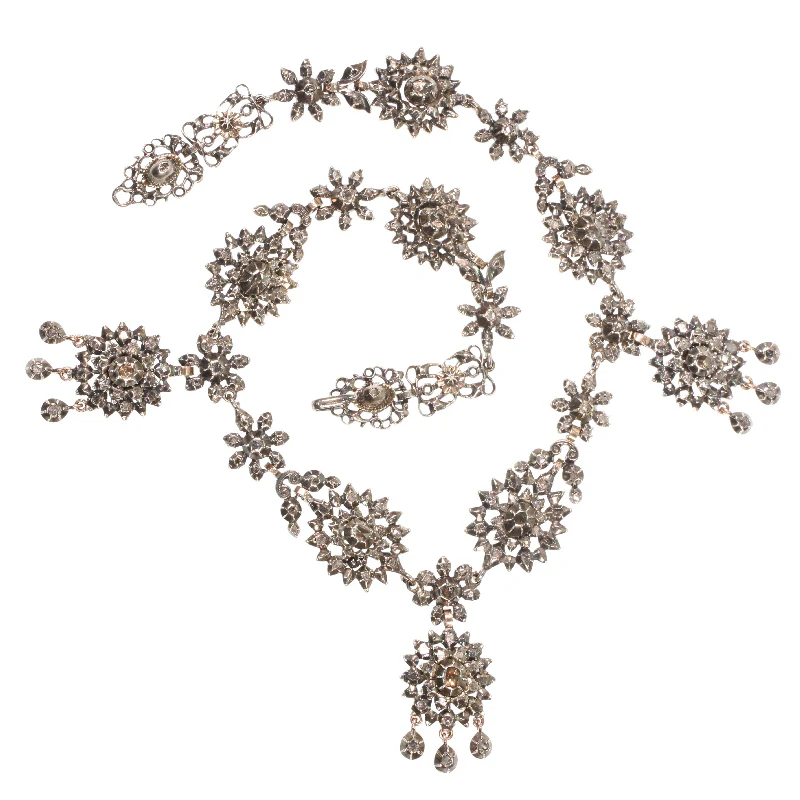
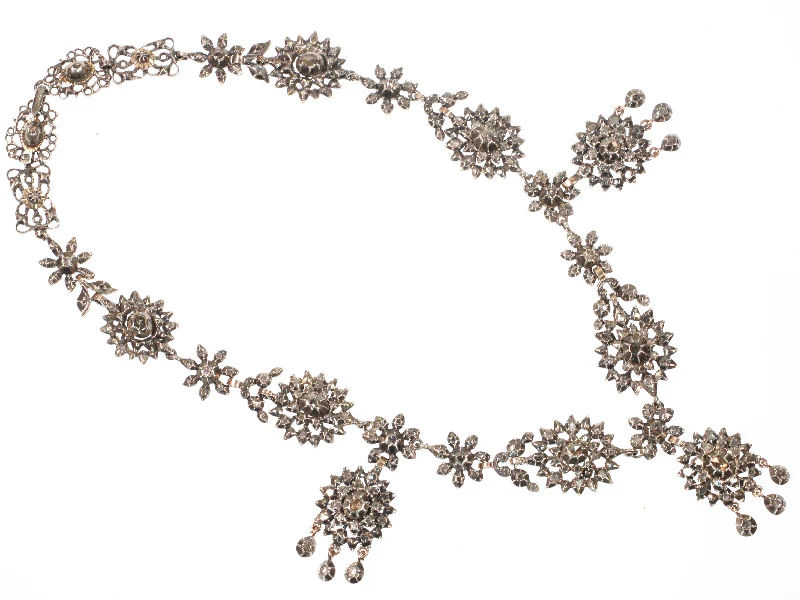
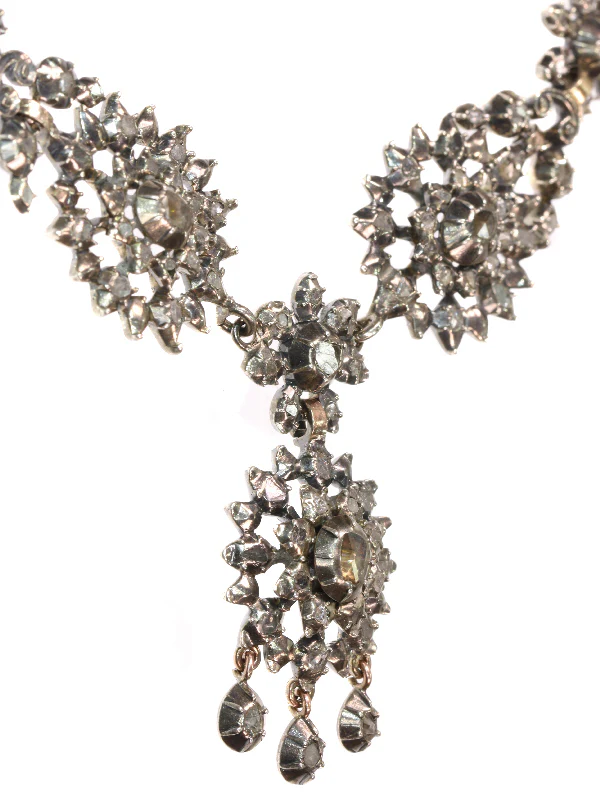
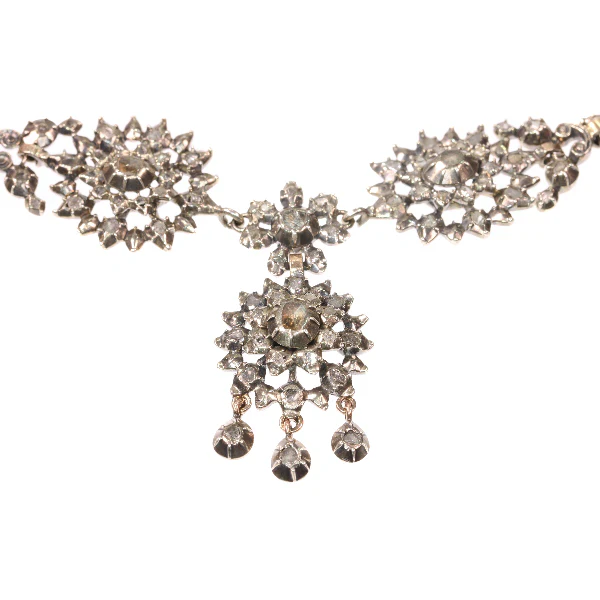
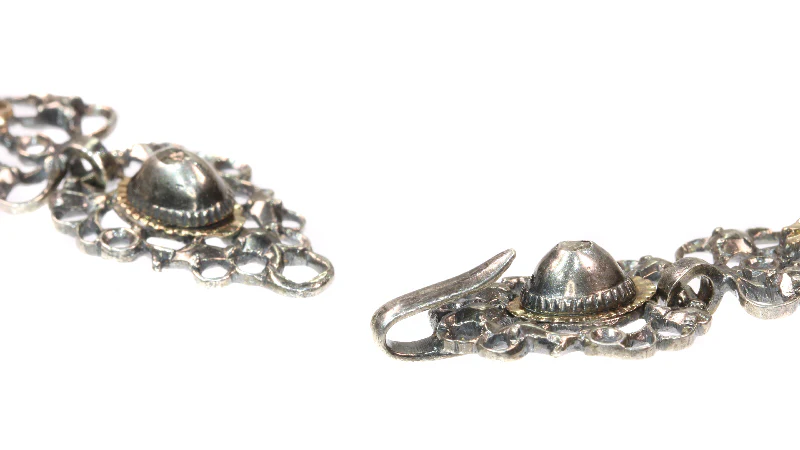
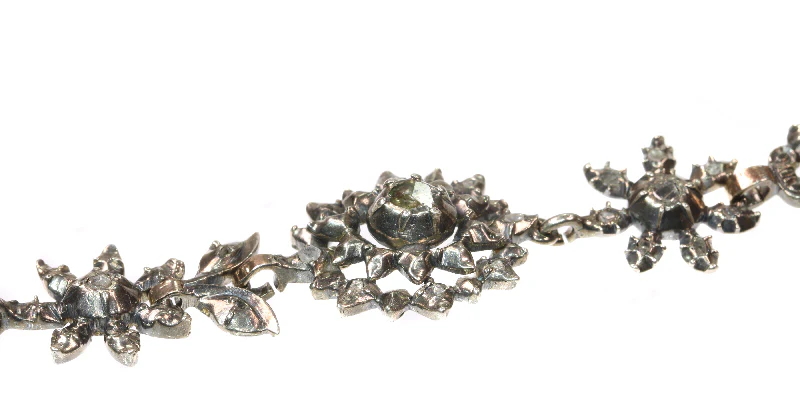
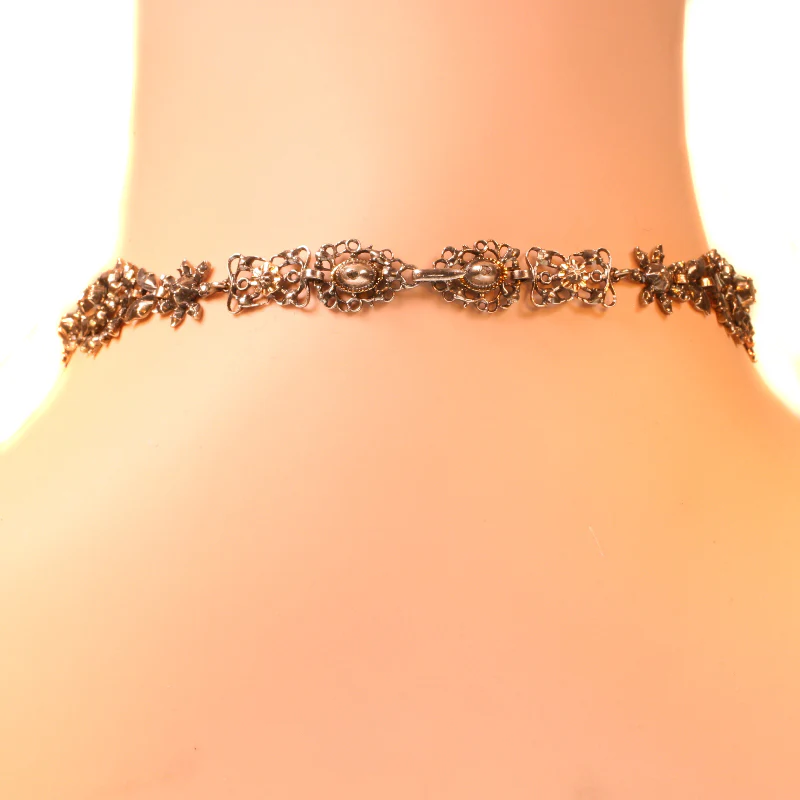
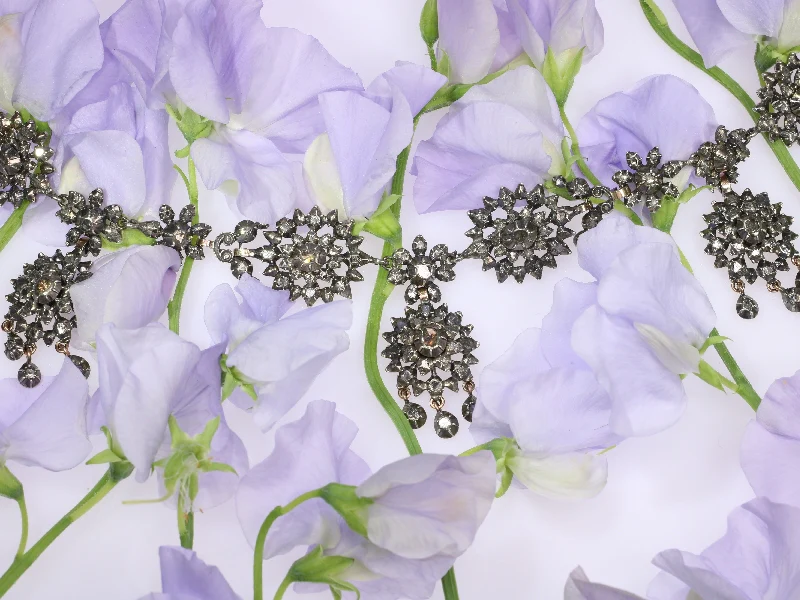
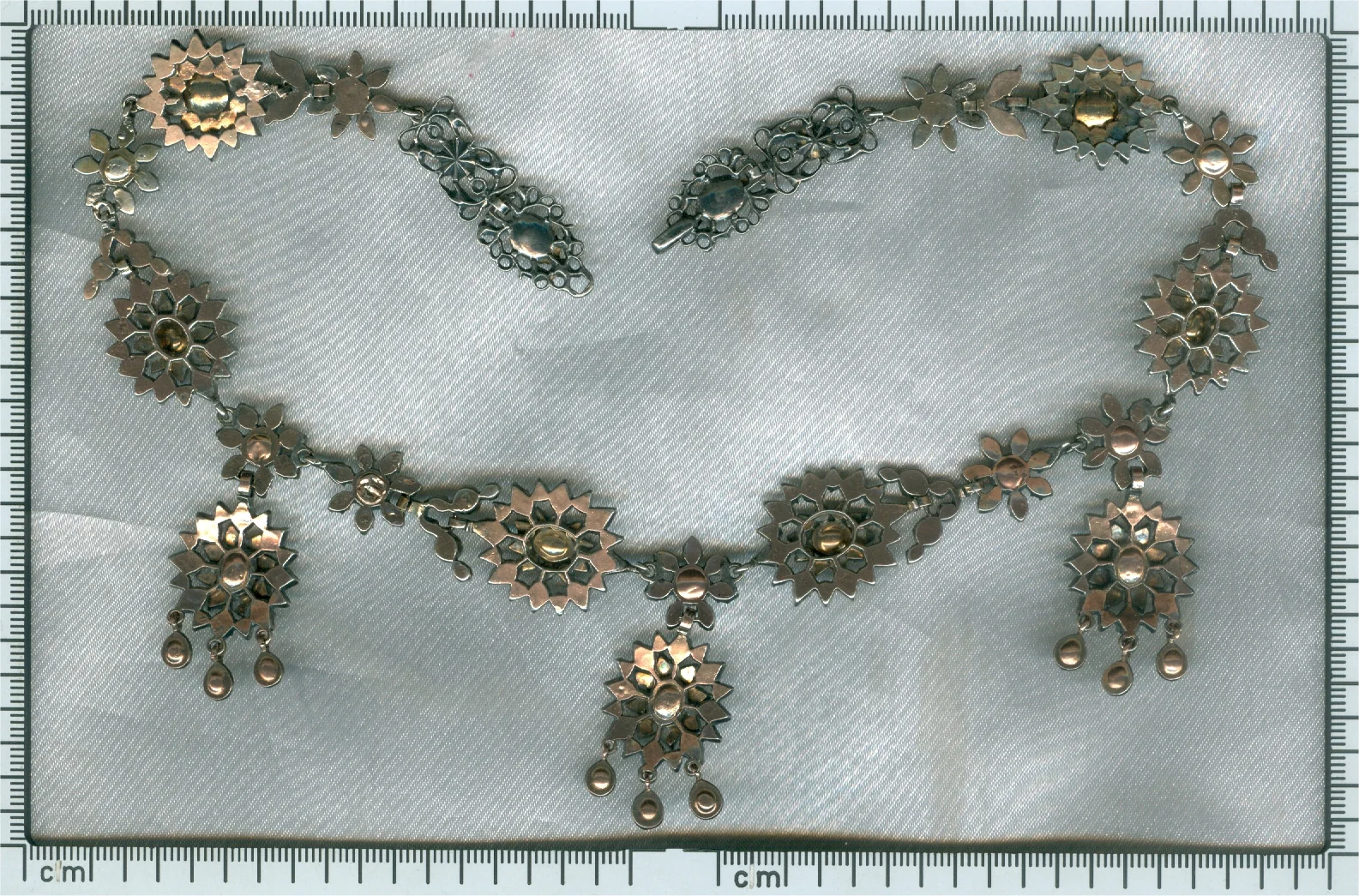
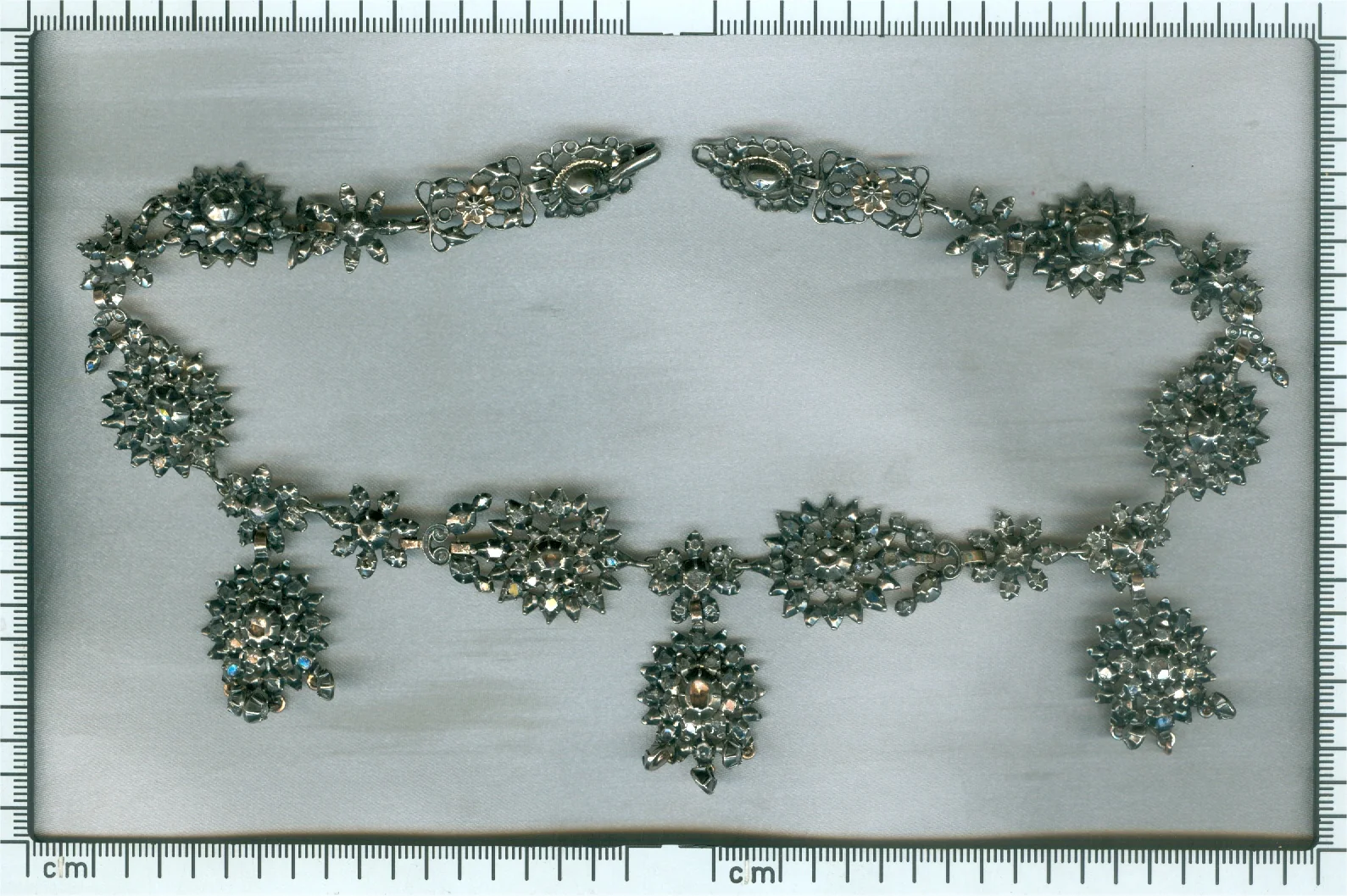
At first glance, it is immediately evident that this frivolous necklace, supported by a red gold back, fits elegantly around the neck, like a garland of six large flowers alternating with six smaller ones. While three other pairs of flowers, accompanied by suspended triplets, detach from this flourishing aura, a profusion of rose-cut diamonds set leaf-wise, inlaid in the silver, sparkle brilliantly.
However, this intriguing piece hides much more than meets the eye...
Every antique jewel breathes history, but in addition, this enchanting necklace dating from around 1850 also has a modern story to tell about what jewelry can symbolize for a family.
We had the honor of acquiring this jewel from the heirs of a jeweler, who crafted this unique necklace from his personal collection of four pairs of antique Flemish earrings. Finding a complete pair of this type of earrings is incredibly rare, and even more so to own four pairs. Furthermore, all his daughters shone at every wedding by wearing their father's creation.
Although it is not our habit to offer redesigned/remodeled pieces, the way this jewel was born is simply charming: initiated by a passion for antique jewelry, fueled by the vision and know-how of a jeweler and truly ignited by a father's love.
Group of antique jewelry objects:
necklace
Condition:
very good condition
- (more info on our condition scale)
Country of origin:
Although it does not bear any readable control mark, we believe it to be of Belgian origin.
Style:
Victorian – Victorian decorative arts refer to the style of decorative arts from the Victorian era. This era is known for its eclectic revival and interpretation of historical styles, as well as the introduction of intercultural influences from the Middle East and Asia into furniture, accessories, and interior decoration. Victorian design is widely perceived as having shown a regrettable excess of ornament. The Arts and Crafts movement, the aesthetic movement, the Anglo-Japanese style, and Art Nouveau all have their origins at the end of the Victorian era.
- See also: Victorian or more information on styles
Style specifics:
The Romantic Victorian Period - Experts divide the reign of Queen Victoria, also known as the Victorian era (1837 - 1901), into three periods of about twenty years each: the Romantic Victorian Period (1837 - 1860), the Grand Victorian Period (1860 - 1880), and the Late or Aesthetic Victorian Period (1880 - 1901).
We consider this period to belong to the Romantic Victorian Period. This period covers the coronation of Victoria as Queen of Great Britain and Ireland, her marriage to King Albert, their love and devotion to their marriage and their country, which were sources of inspiration. The jewelry from this period is made with intricate carvings, special techniques where enamel is subtly worked. These techniques allowed the jewelry to have a certain opulence with less precious metal. Precious metals were very rare at that time. The most prized (semi-)precious stones of the era were amethyst, coral, garnets, cultured pearls, and turquoise. The connotation is obviously sentimental, symbolic, and romantic, with motifs reminiscent of the Gothic and/or Renaissance style, and abundant use of motifs such as anchors, birds, branches, crosses, hearts, and snakes.
Period:
circa 1850
- (events and facts from this era, poetry from this era, fashion from this era)
Material:
silver on top and supported by 18-carat red gold (see explanation about silver on gold).
- (more info on precious metals)
Technique:
Rose-cut diamonds are set on foil. This special technique was used to enhance the brilliance of the diamonds.
Diamond(s):
Numerous rose-cut diamonds and senailles. A senaille is a simplified rose-cut diamond, a small diamond chip with sometimes a few polished facets. We do not have the weight of the rose-cut diamonds or the senailles, unlike what is common in our profession.
Birthstones:
Diamond is the birthstone (or month stone) of April.
- (more info on birthstones)
Hallmarks:
None found.
- (more info on hallmarks)
Dimensions:
total length 41.50 cm (16.34 inches)
Weight:
66.40 grams (42.70 dwt)
More Images
A father's love: the Victorian diamond garland necklace from the 1850s
At first glance, it is immediately evident that this frivolous necklace, supported by a red gold back, fits elegantly around the neck, like a garland of six large flowers alternating with six smaller ones. While three other pairs of flowers, accompanied by suspended triplets, detach from this flourishing aura, a profusion of rose-cut diamonds set leaf-wise, inlaid in the silver, sparkle brilliantly.
However, this intriguing piece hides much more than meets the eye...
Every antique jewel breathes history, but in addition, this enchanting necklace dating from around 1850 also has a modern story to tell about what jewelry can symbolize for a family.
We had the honor of acquiring this jewel from the heirs of a jeweler, who crafted this unique necklace from his personal collection of four pairs of antique Flemish earrings. Finding a complete pair of this type of earrings is incredibly rare, and even more so to own four pairs. Furthermore, all his daughters shone at every wedding by wearing their father's creation.
Although it is not our habit to offer redesigned/remodeled pieces, the way this jewel was born is simply charming: initiated by a passion for antique jewelry, fueled by the vision and know-how of a jeweler and truly ignited by a father's love.
Group of antique jewelry objects:
necklace
Condition:
very good condition
- (more info on our condition scale)
Country of origin:
Although it does not bear any readable control mark, we believe it to be of Belgian origin.
Style:
Victorian – Victorian decorative arts refer to the style of decorative arts from the Victorian era. This era is known for its eclectic revival and interpretation of historical styles, as well as the introduction of intercultural influences from the Middle East and Asia into furniture, accessories, and interior decoration. Victorian design is widely perceived as having shown a regrettable excess of ornament. The Arts and Crafts movement, the aesthetic movement, the Anglo-Japanese style, and Art Nouveau all have their origins at the end of the Victorian era.
- See also: Victorian or more information on styles
Style specifics:
The Romantic Victorian Period - Experts divide the reign of Queen Victoria, also known as the Victorian era (1837 - 1901), into three periods of about twenty years each: the Romantic Victorian Period (1837 - 1860), the Grand Victorian Period (1860 - 1880), and the Late or Aesthetic Victorian Period (1880 - 1901).
We consider this period to belong to the Romantic Victorian Period. This period covers the coronation of Victoria as Queen of Great Britain and Ireland, her marriage to King Albert, their love and devotion to their marriage and their country, which were sources of inspiration. The jewelry from this period is made with intricate carvings, special techniques where enamel is subtly worked. These techniques allowed the jewelry to have a certain opulence with less precious metal. Precious metals were very rare at that time. The most prized (semi-)precious stones of the era were amethyst, coral, garnets, cultured pearls, and turquoise. The connotation is obviously sentimental, symbolic, and romantic, with motifs reminiscent of the Gothic and/or Renaissance style, and abundant use of motifs such as anchors, birds, branches, crosses, hearts, and snakes.
Period:
circa 1850
- (events and facts from this era, poetry from this era, fashion from this era)
Material:
silver on top and supported by 18-carat red gold (see explanation about silver on gold).
- (more info on precious metals)
Technique:
Rose-cut diamonds are set on foil. This special technique was used to enhance the brilliance of the diamonds.
Diamond(s):
Numerous rose-cut diamonds and senailles. A senaille is a simplified rose-cut diamond, a small diamond chip with sometimes a few polished facets. We do not have the weight of the rose-cut diamonds or the senailles, unlike what is common in our profession.
Birthstones:
Diamond is the birthstone (or month stone) of April.
- (more info on birthstones)
Hallmarks:
None found.
- (more info on hallmarks)
Dimensions:
total length 41.50 cm (16.34 inches)
Weight:
66.40 grams (42.70 dwt)
Product Information
Product Information
Shipping & Returns
Shipping & Returns
Description
At first glance, it is immediately evident that this frivolous necklace, supported by a red gold back, fits elegantly around the neck, like a garland of six large flowers alternating with six smaller ones. While three other pairs of flowers, accompanied by suspended triplets, detach from this flourishing aura, a profusion of rose-cut diamonds set leaf-wise, inlaid in the silver, sparkle brilliantly.
However, this intriguing piece hides much more than meets the eye...
Every antique jewel breathes history, but in addition, this enchanting necklace dating from around 1850 also has a modern story to tell about what jewelry can symbolize for a family.
We had the honor of acquiring this jewel from the heirs of a jeweler, who crafted this unique necklace from his personal collection of four pairs of antique Flemish earrings. Finding a complete pair of this type of earrings is incredibly rare, and even more so to own four pairs. Furthermore, all his daughters shone at every wedding by wearing their father's creation.
Although it is not our habit to offer redesigned/remodeled pieces, the way this jewel was born is simply charming: initiated by a passion for antique jewelry, fueled by the vision and know-how of a jeweler and truly ignited by a father's love.
Group of antique jewelry objects:
necklace
Condition:
very good condition
- (more info on our condition scale)
Country of origin:
Although it does not bear any readable control mark, we believe it to be of Belgian origin.
Style:
Victorian – Victorian decorative arts refer to the style of decorative arts from the Victorian era. This era is known for its eclectic revival and interpretation of historical styles, as well as the introduction of intercultural influences from the Middle East and Asia into furniture, accessories, and interior decoration. Victorian design is widely perceived as having shown a regrettable excess of ornament. The Arts and Crafts movement, the aesthetic movement, the Anglo-Japanese style, and Art Nouveau all have their origins at the end of the Victorian era.
- See also: Victorian or more information on styles
Style specifics:
The Romantic Victorian Period - Experts divide the reign of Queen Victoria, also known as the Victorian era (1837 - 1901), into three periods of about twenty years each: the Romantic Victorian Period (1837 - 1860), the Grand Victorian Period (1860 - 1880), and the Late or Aesthetic Victorian Period (1880 - 1901).
We consider this period to belong to the Romantic Victorian Period. This period covers the coronation of Victoria as Queen of Great Britain and Ireland, her marriage to King Albert, their love and devotion to their marriage and their country, which were sources of inspiration. The jewelry from this period is made with intricate carvings, special techniques where enamel is subtly worked. These techniques allowed the jewelry to have a certain opulence with less precious metal. Precious metals were very rare at that time. The most prized (semi-)precious stones of the era were amethyst, coral, garnets, cultured pearls, and turquoise. The connotation is obviously sentimental, symbolic, and romantic, with motifs reminiscent of the Gothic and/or Renaissance style, and abundant use of motifs such as anchors, birds, branches, crosses, hearts, and snakes.
Period:
circa 1850
- (events and facts from this era, poetry from this era, fashion from this era)
Material:
silver on top and supported by 18-carat red gold (see explanation about silver on gold).
- (more info on precious metals)
Technique:
Rose-cut diamonds are set on foil. This special technique was used to enhance the brilliance of the diamonds.
Diamond(s):
Numerous rose-cut diamonds and senailles. A senaille is a simplified rose-cut diamond, a small diamond chip with sometimes a few polished facets. We do not have the weight of the rose-cut diamonds or the senailles, unlike what is common in our profession.
Birthstones:
Diamond is the birthstone (or month stone) of April.
- (more info on birthstones)
Hallmarks:
None found.
- (more info on hallmarks)
Dimensions:
total length 41.50 cm (16.34 inches)
Weight:
66.40 grams (42.70 dwt)