The majesty of the eagle: a Victorian adorned bracelet
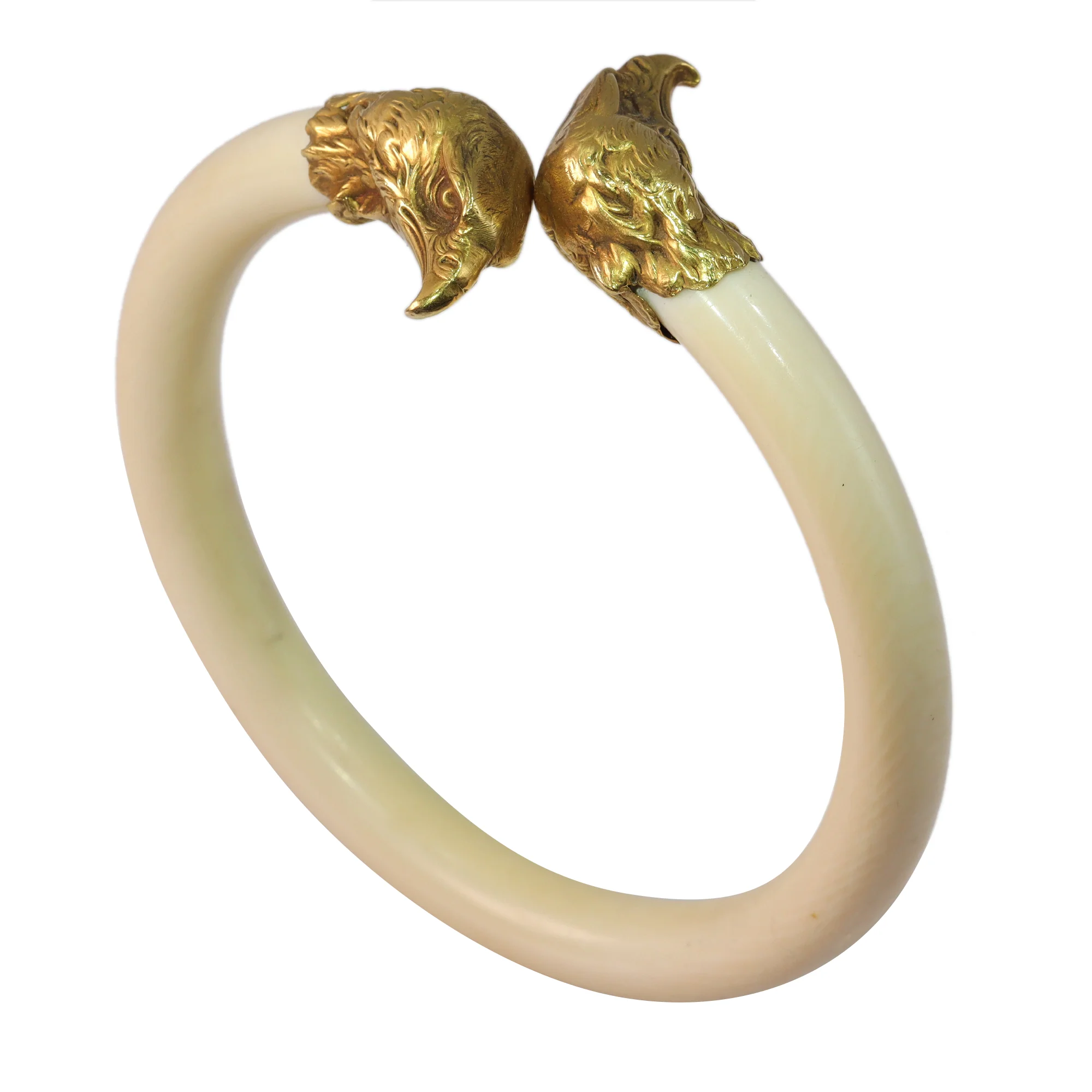
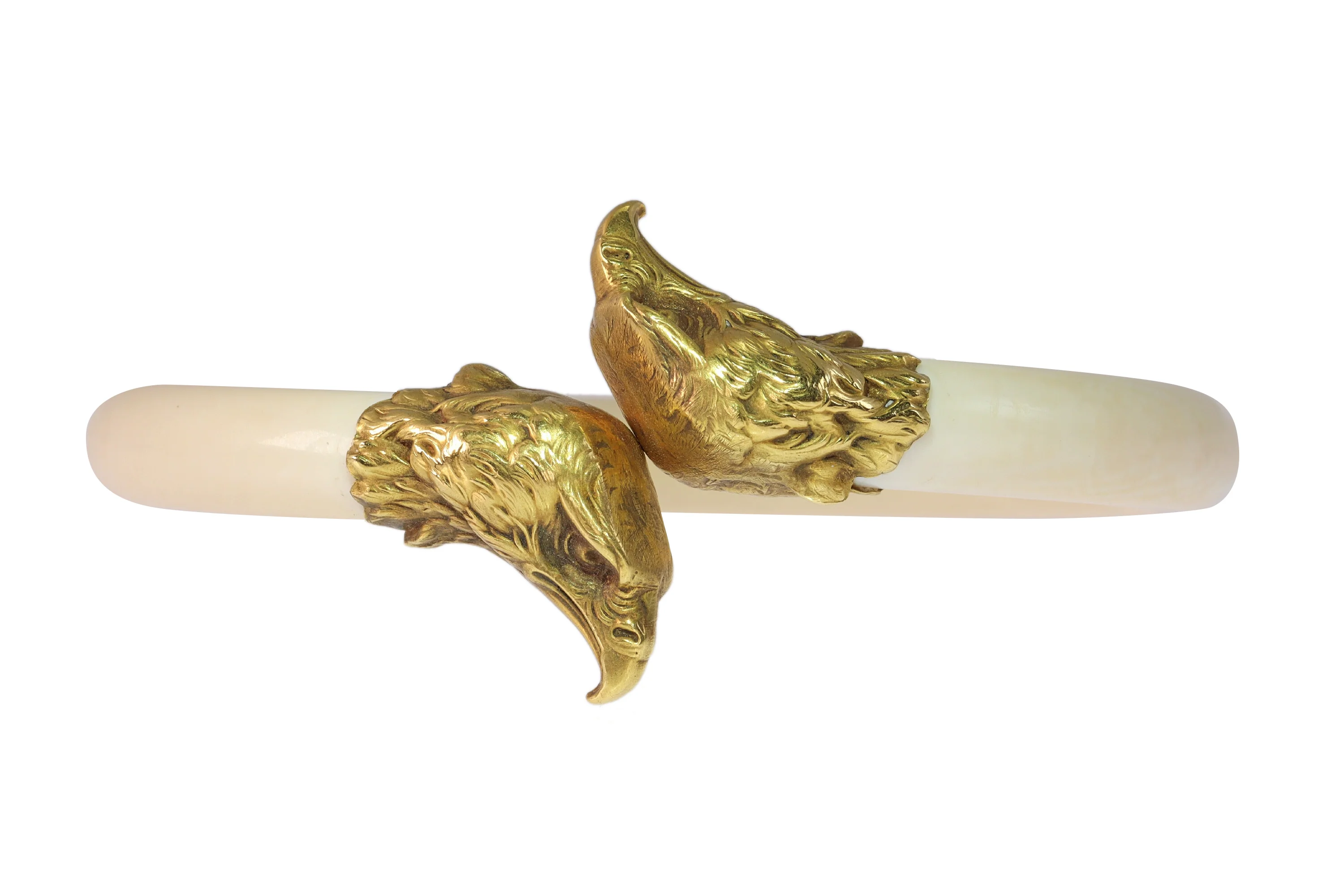
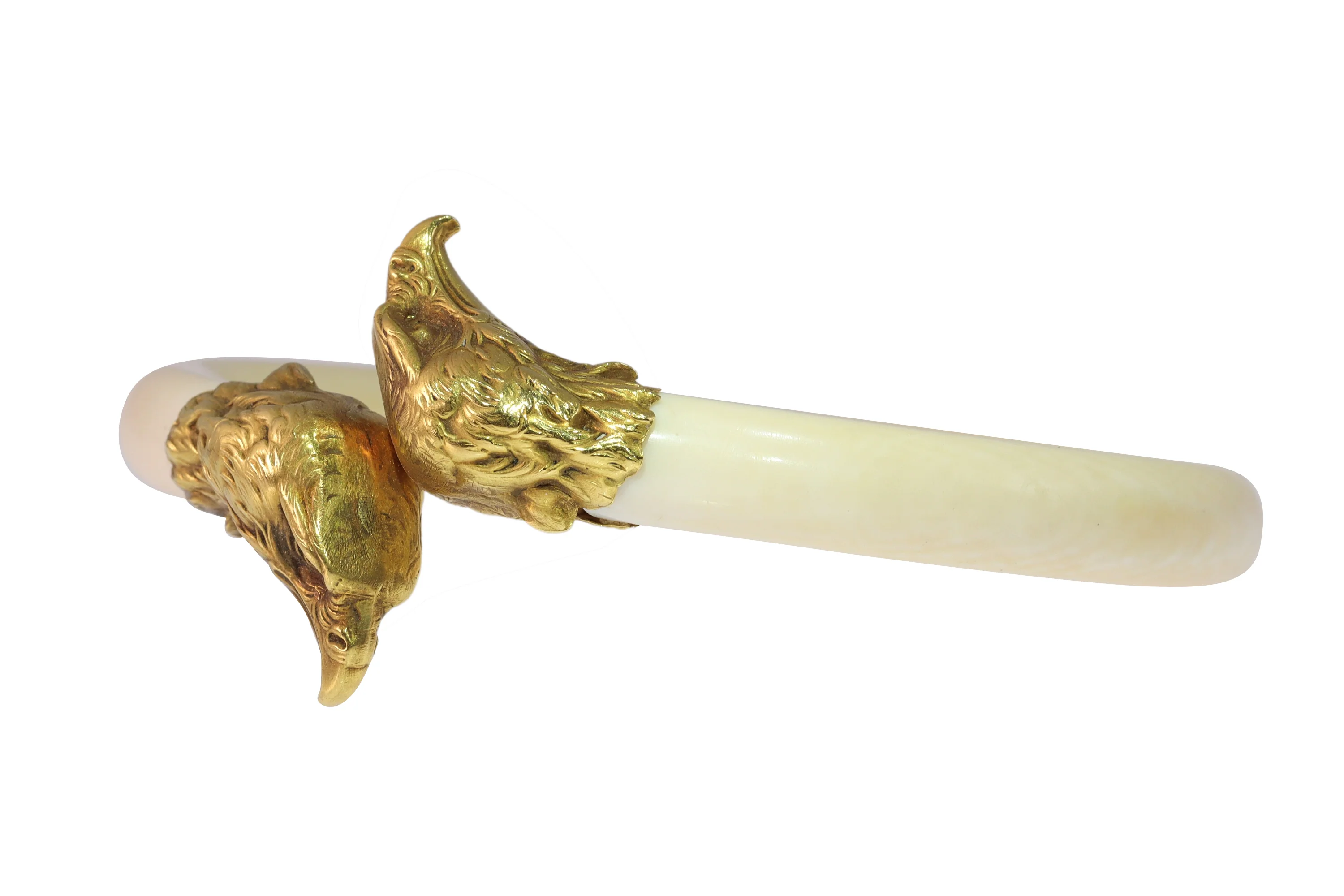
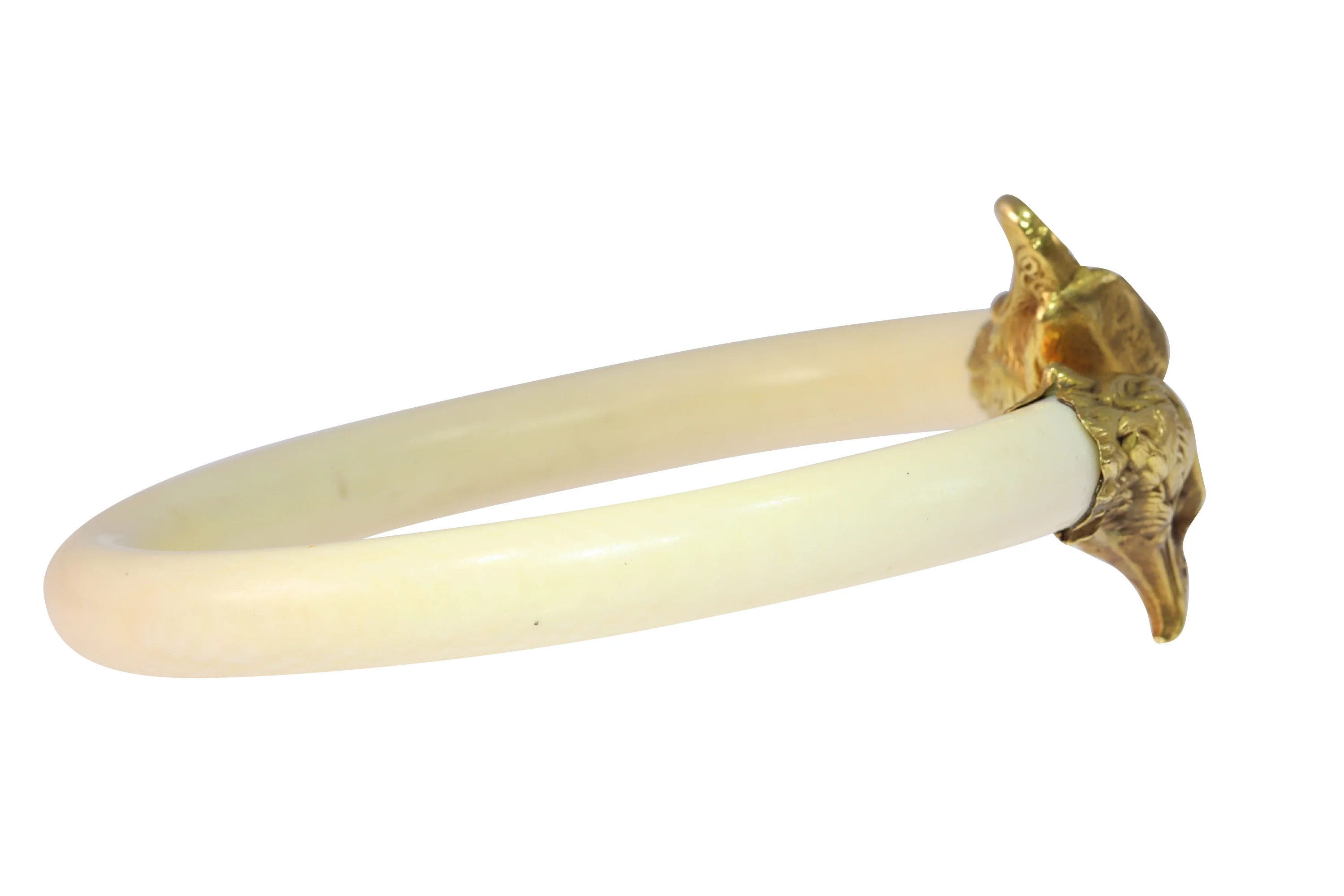
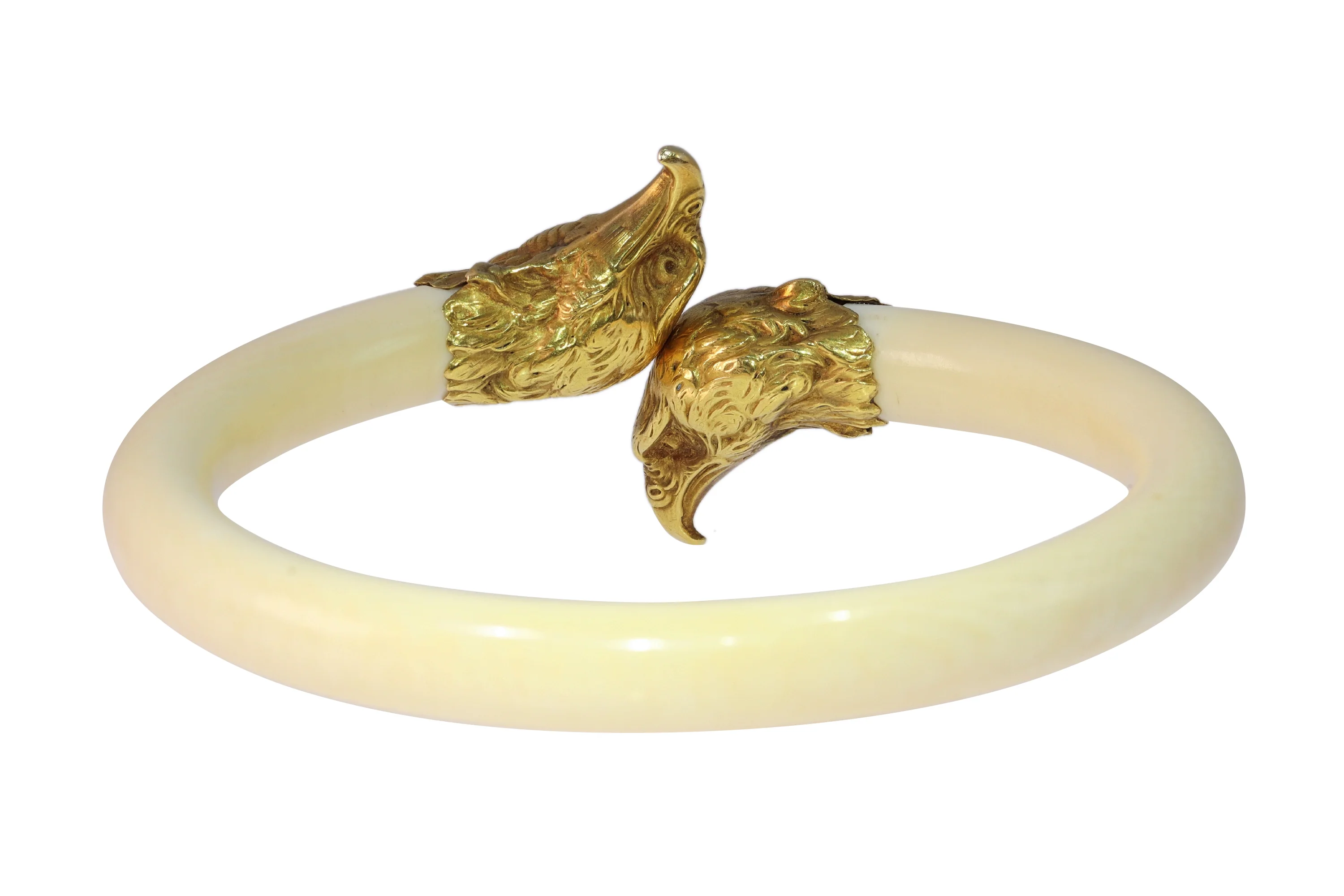
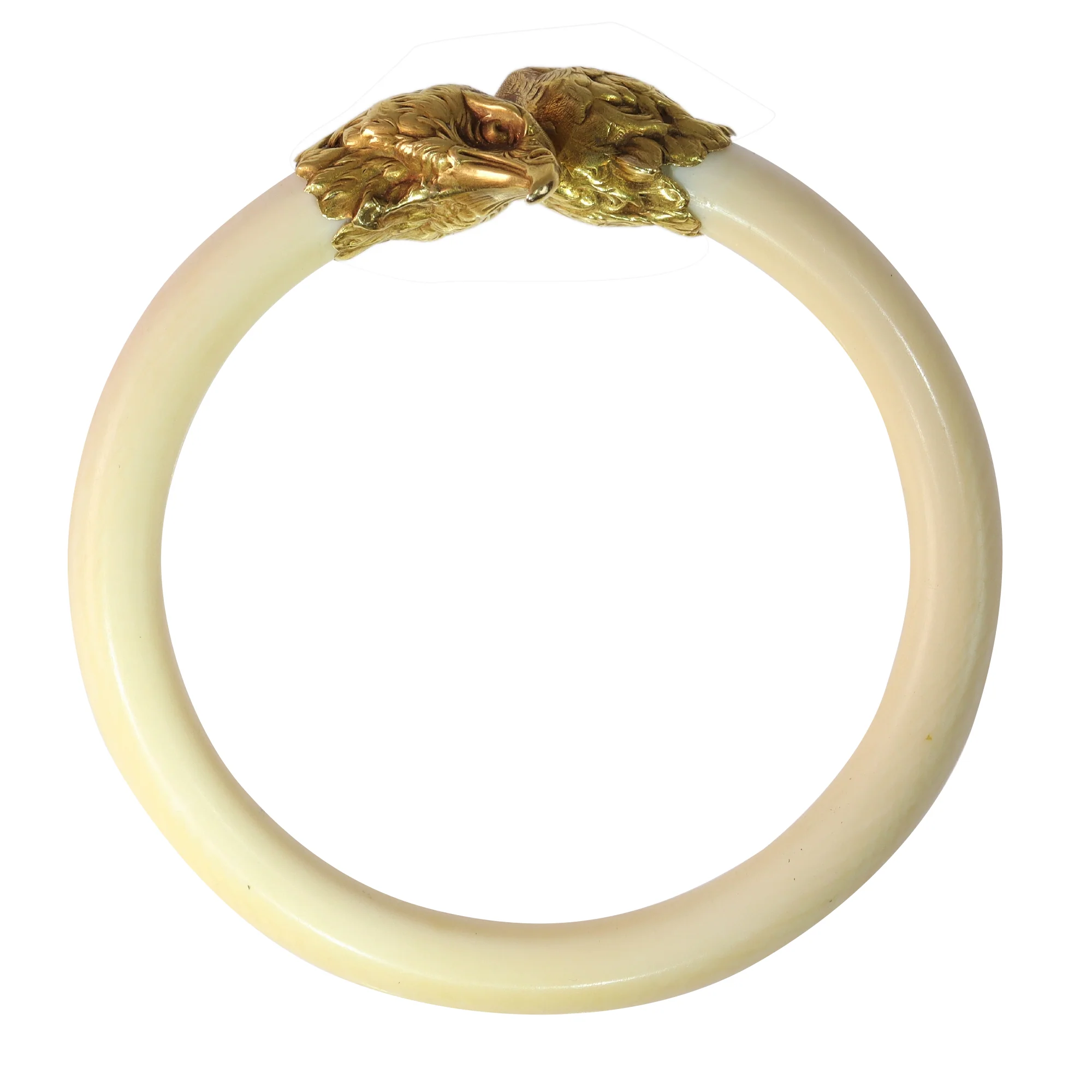
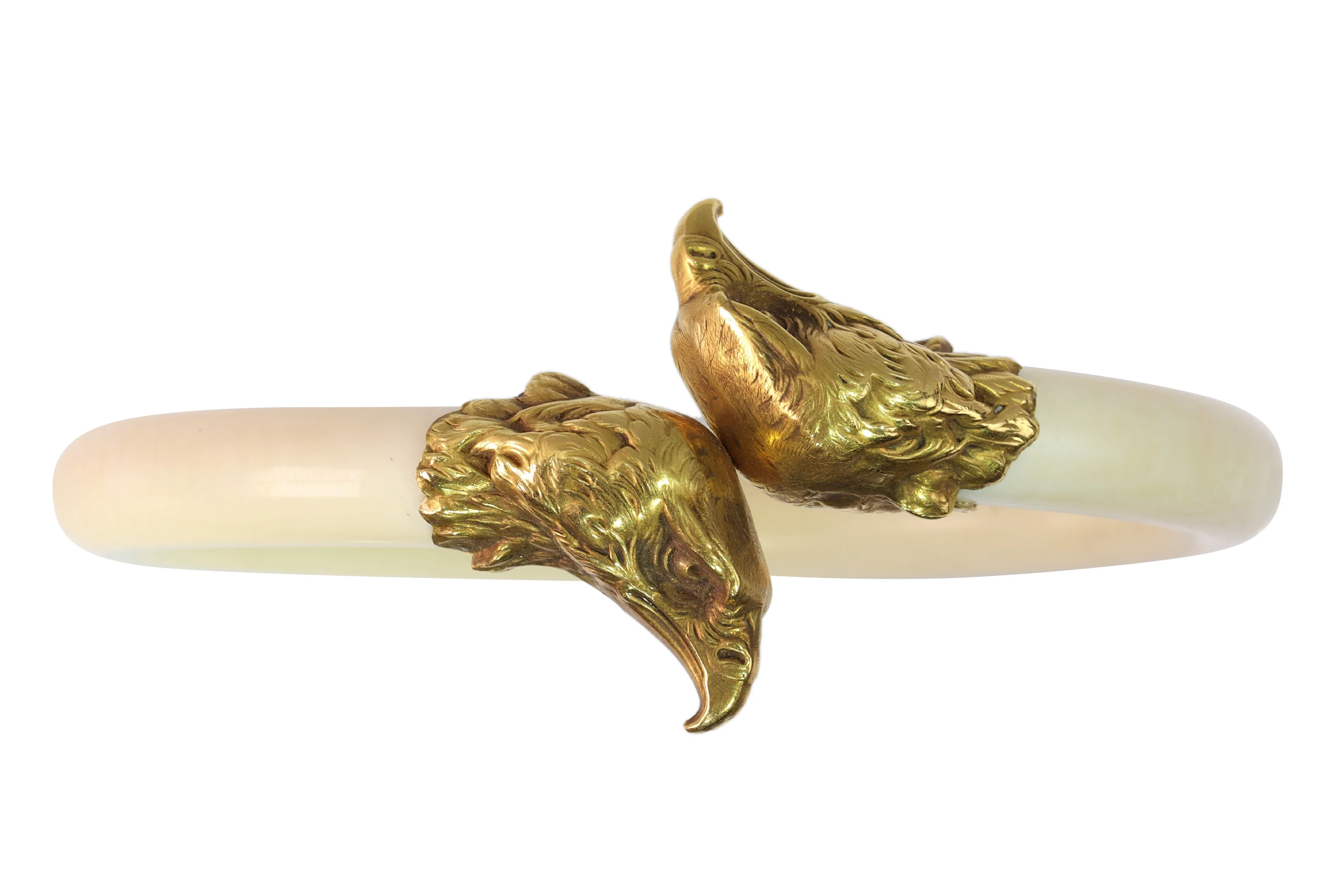
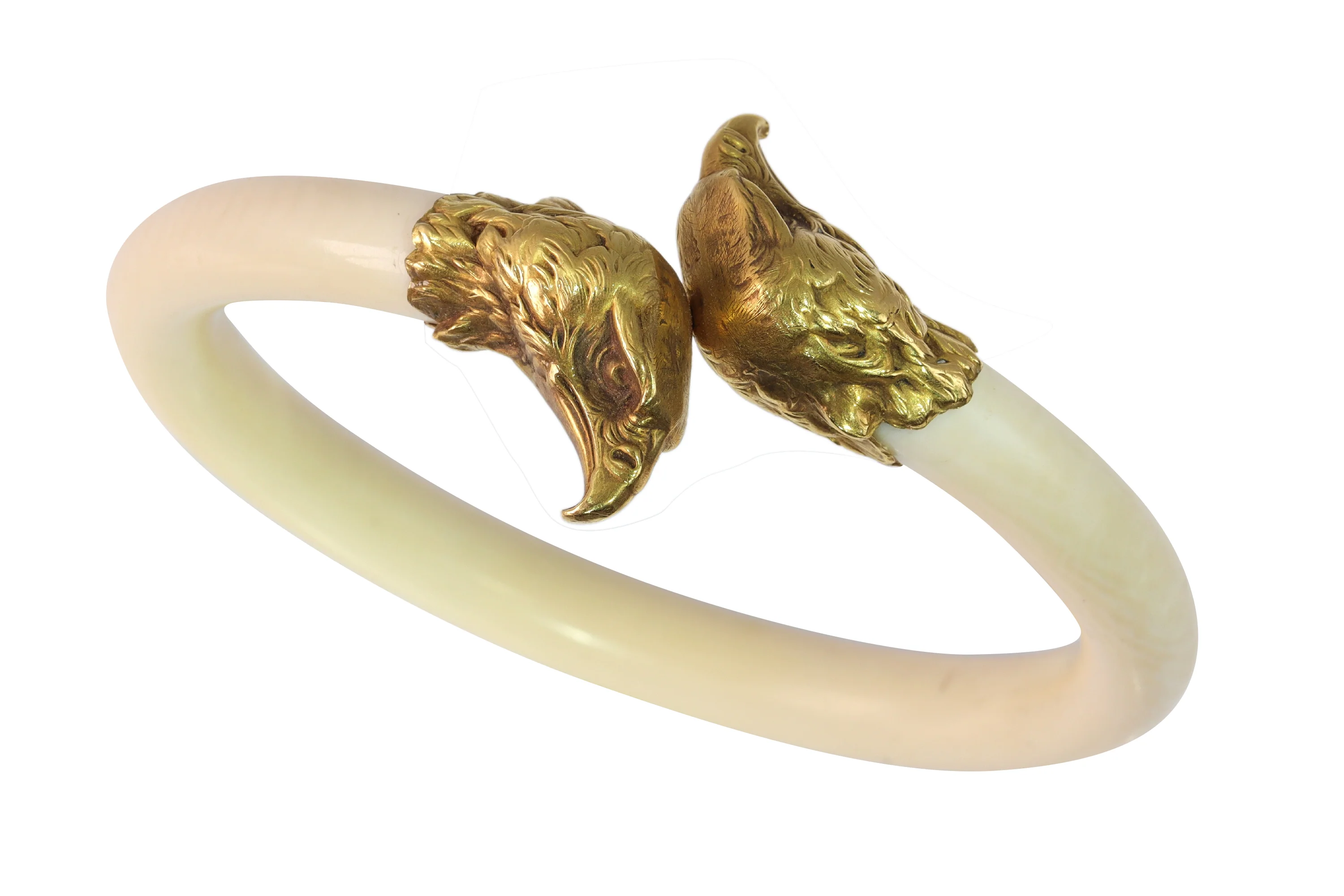
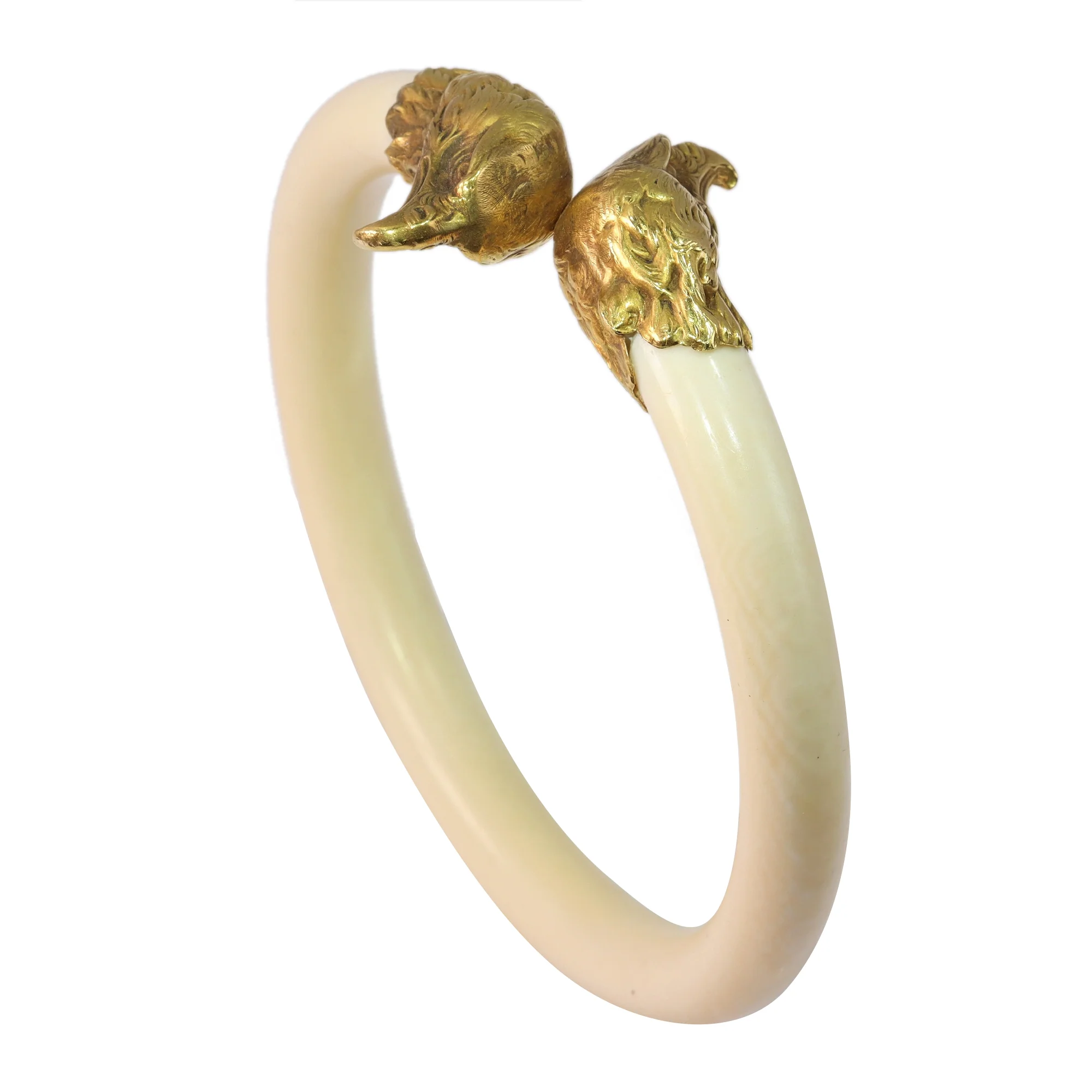
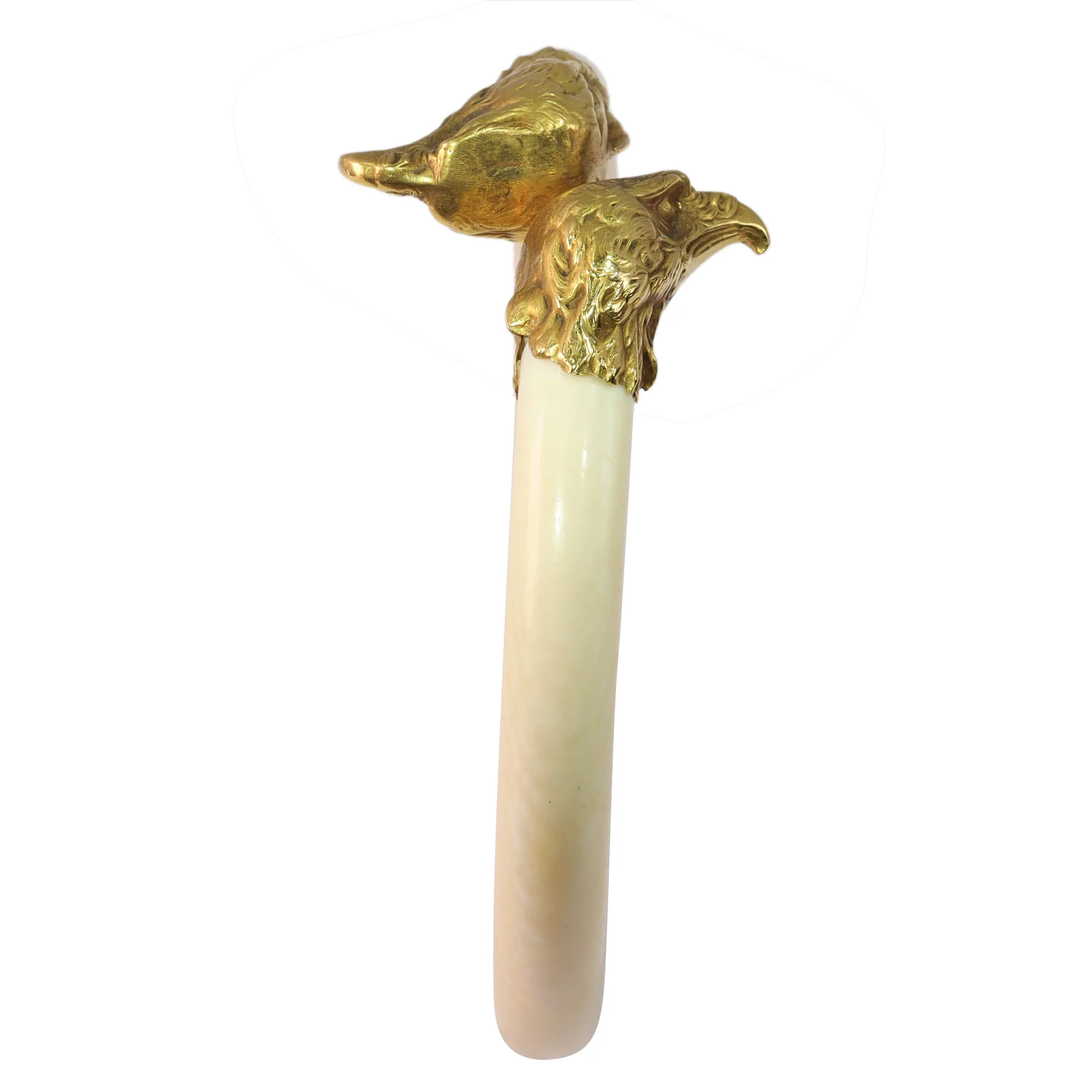
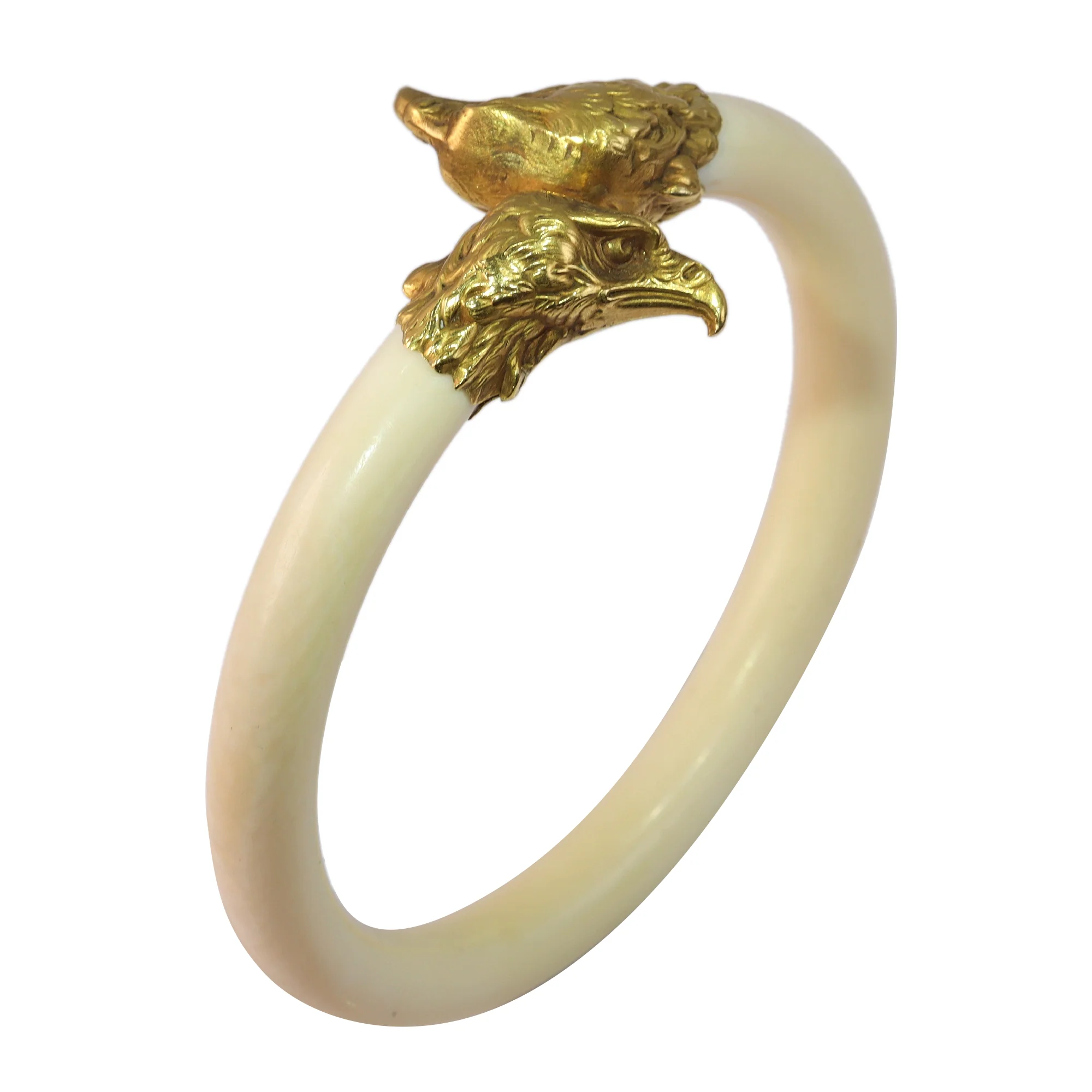
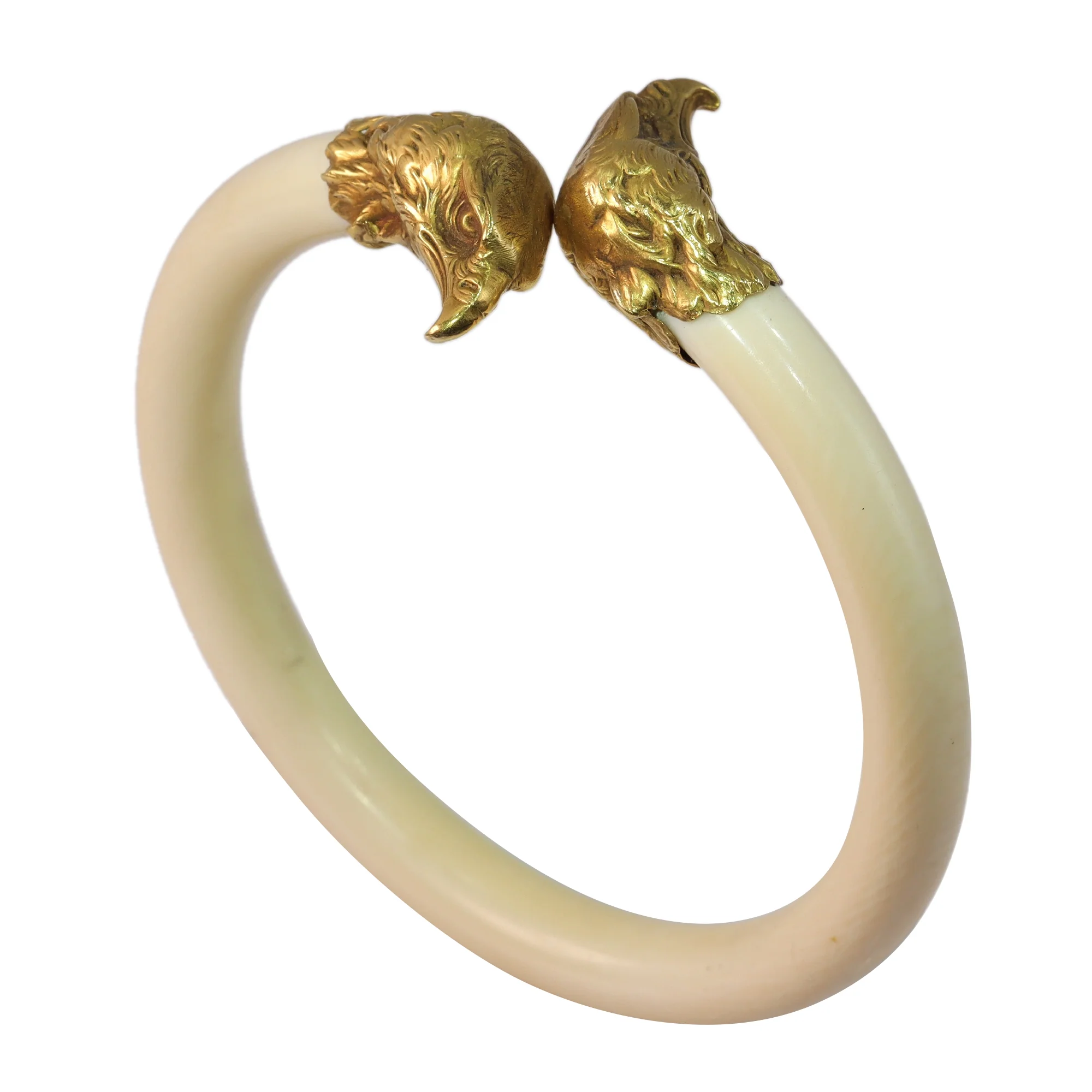
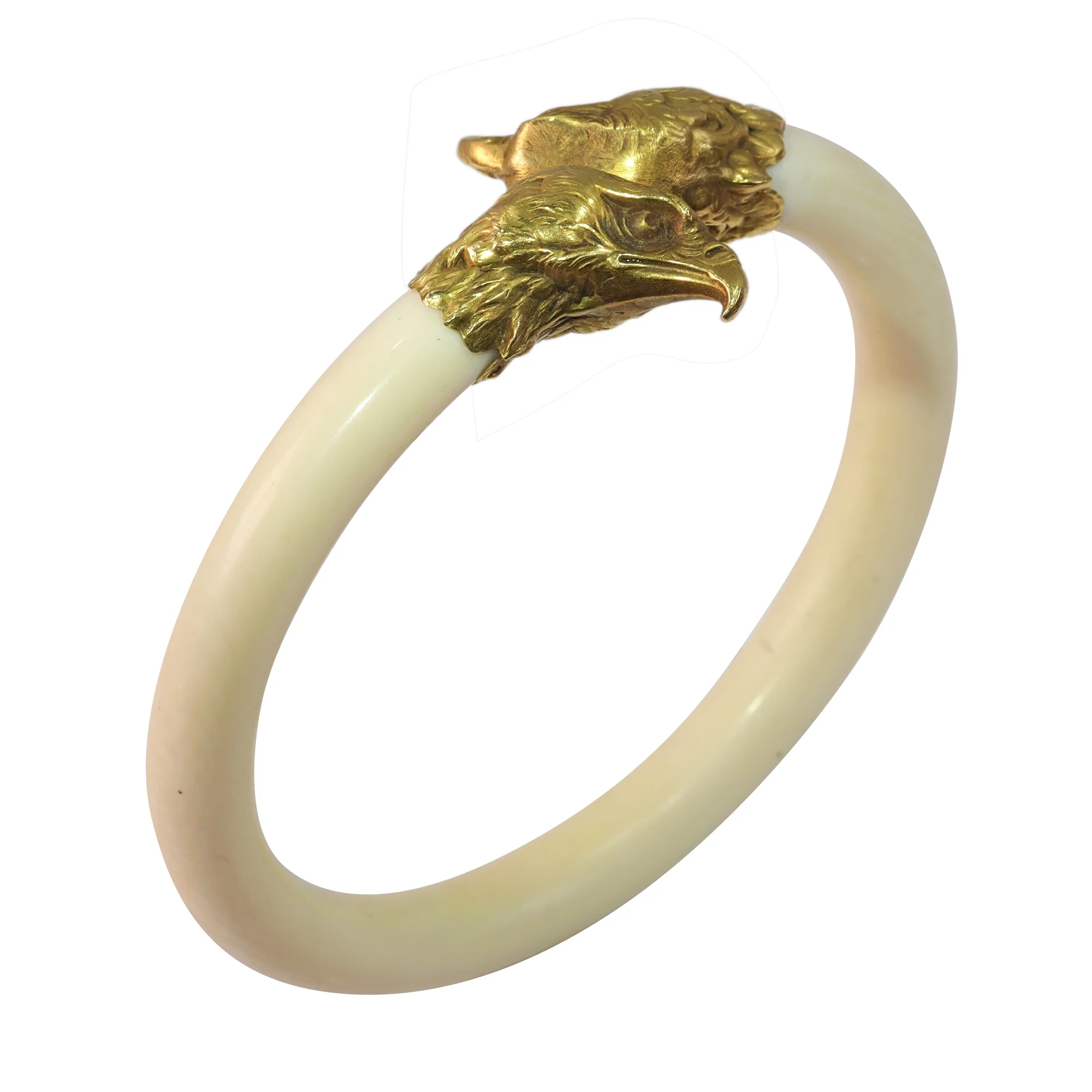
An exquisite French bangle bracelet from the late Victorian era, made from historic ivory and adorned with majestic gold eagle heads, evokes the grandeur of the time. Dating from the 1890s, this piece reflects the exceptional mastery of goldsmithing and sculpture, synonymous with French art. Without a maker’s mark, its hallmark nevertheless attests to its French origin. In excellent condition, the eagle heads, ingeniously designed to pivot on the wrist, embody the spirit of innovation that linked Victorian opulence and the emerging Art Nouveau movement.
First, we welcome the ban on the trade of modern ivory. Next, we clarify that this piece is over 100 years old and was made at a time when global awareness of the threat to endangered species was not yet fully realized. We hesitated to buy it, as we generally do not purchase ivory. What appealed to us is that this bracelet beautifully reflects the era in which it was made, the late 19th century, showcasing the great craftsmanship of French goldsmiths and sculptors for which it is renowned.
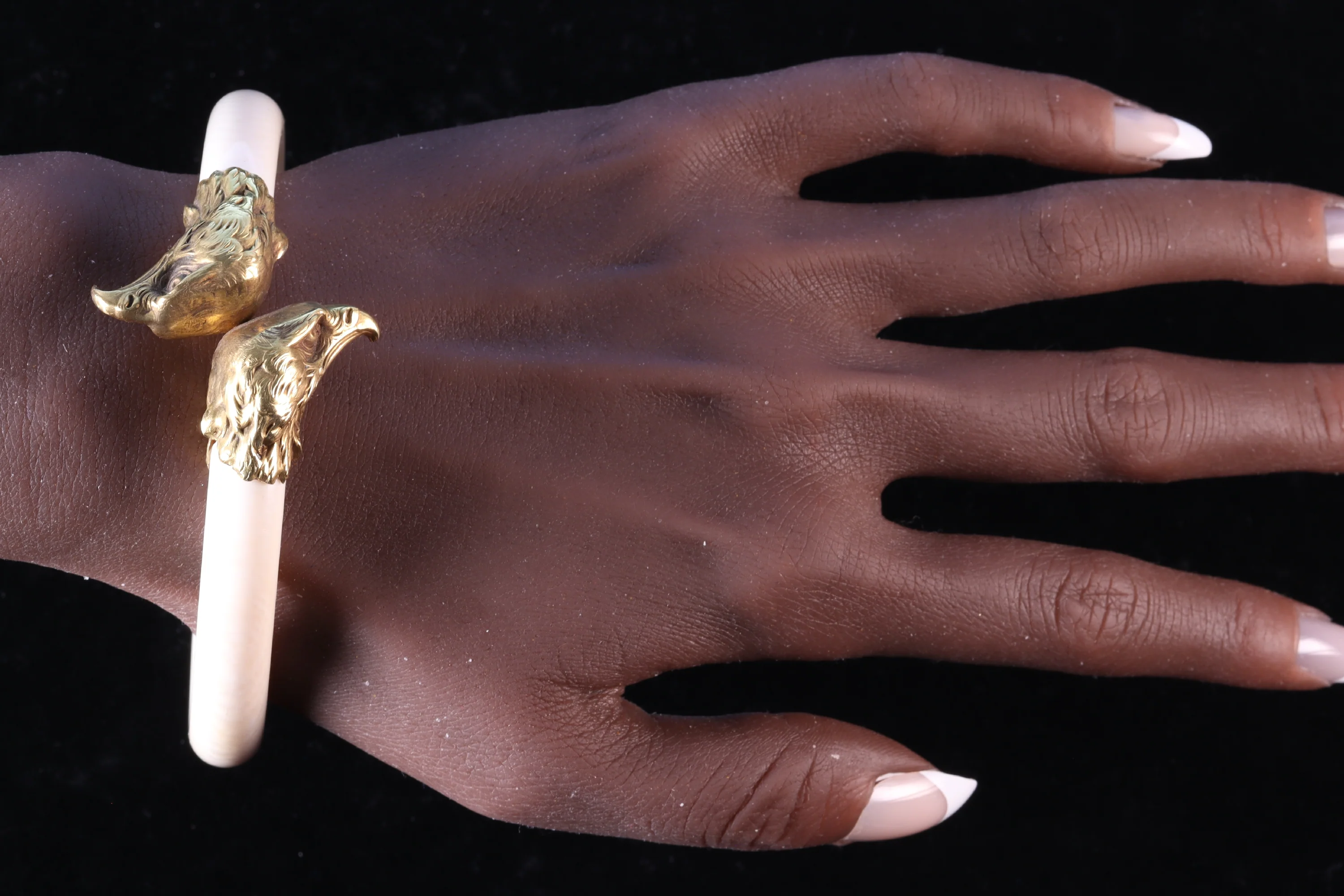
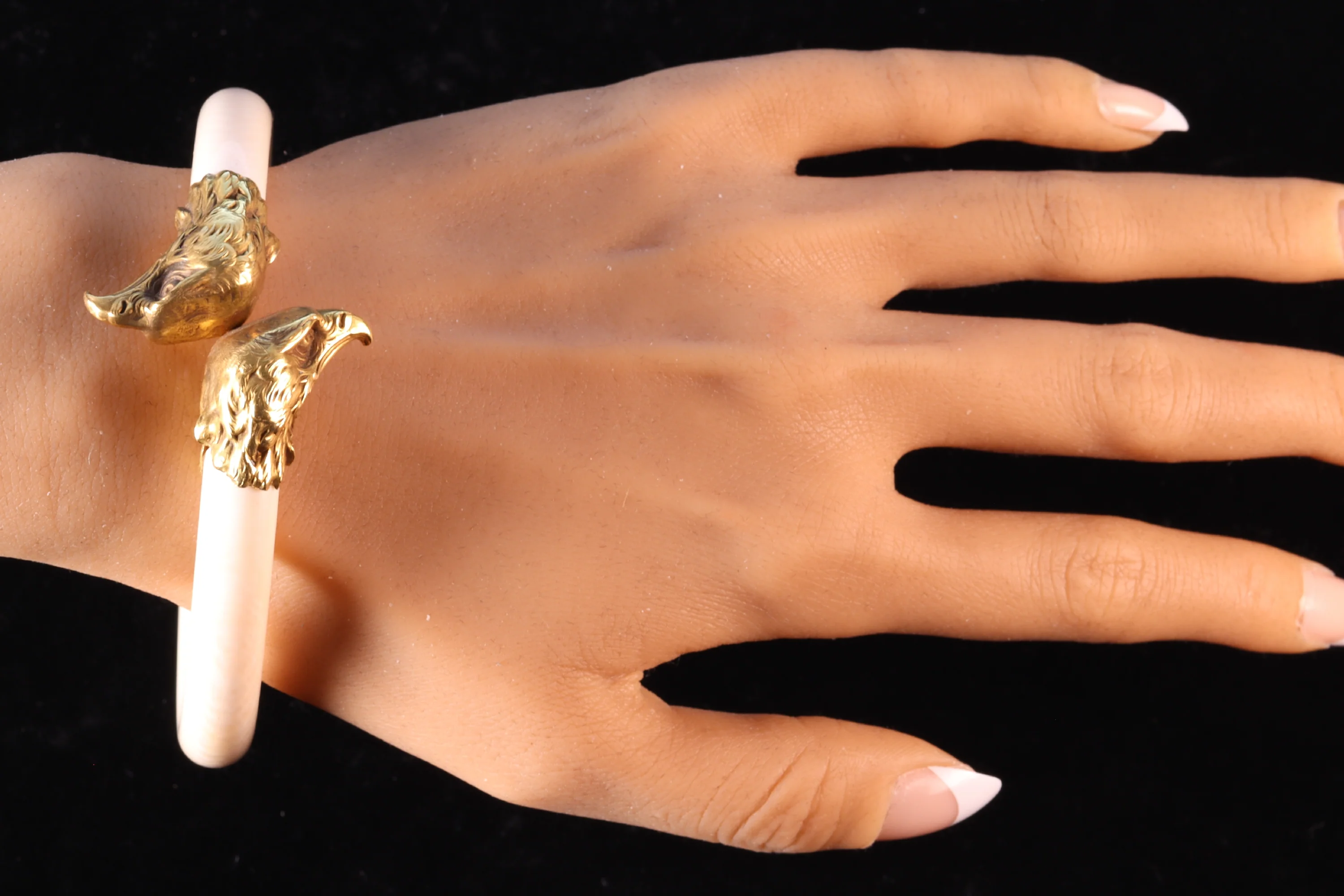
An extremely decorative bracelet in intact ivory, adorned with solid gold eagle heads with a realistic appearance, and stamped with French hallmarks. Unfortunately, we found no maker’s mark. But even if we found one, our chances of identifying the jeweler who made it would be slim, as the index of French maker’s marks is one of the most difficult to consult. It is designed to be worn, as the heads can be slightly turned once on the wrist.
We contacted the Belgian Environmental Office and were informed that within the European Community, we do not need a CITES certificate for this bracelet, as it is antique. A CITES document is only required if the customer resides outside the European Community. We can only request this certificate with the buyer’s name, and the Belgian Environmental Office may take up to two weeks to send it to us.
Antique jewelry group:
bracelet
Condition:
excellent condition
- (more info on our condition scale)
Country of origin:
France
Style:
Between Victorian and Art Nouveau – Victorian decorative arts refer to the style of decorative arts from the Victorian era. This period is known for its eclectic revival and interpretation of historic styles, as well as for the introduction of cross-cultural influences from the Middle East and Asia in furniture, fittings, and interior decoration. Victorian design is widely seen as having displayed a regrettable excess of ornamentation.
The Arts and Crafts movement, aesthetic movement, Anglo-Japanese style, and Art Nouveau all have their origins at the end of the Victorian era. Art Nouveau (in French "Nouveau Style") is an international movement and an artistic, architectural, and applied style—especially the decorative arts—which reached its peak at the turn of the 20th century (1890-1905).
The term "Art Nouveau" means "new art" in French. It is also known as "Jugendstil," which means "youth style" in German, after the magazine Jugend, which promoted it, and in Italy as the Liberty style, after the London department store Liberty & Co., which popularized it. A reaction to 19th-century academic art, it is characterized by organic motifs, especially floral and other plant patterns, as well as fluid, stylized curvilinear forms.
Art Nouveau is an approach to design in which artists should work on everything from architecture to furniture, integrating art into everyday life.
- See also: end of the Victorian era, beginning of Art Nouveau,
Style specifics:
End of the Victorian era / beginning of Art Nouveau - The subject of this piece, although typical of the 19th century, heralds the advent of the Art Nouveau style.
Period:
around 1890
- (events and facts from this period, poetry from this period, fashion from this period)
Source of inspiration:
Mother Nature
Theme:
eagle
Material:
18-carat yellow gold
- (more info on precious metals)
Additional information:
Symbolism of the eagle: the eagle symbolizes strength, courage, clairvoyance, and immortality. It is considered the king of the air and the messenger of the supreme gods. Mythologically, it is associated with the god Zeus by the Greeks, Jupiter by the Romans, Odin by the Germans, and God by Christians. Learn more about the eagle and its symbolism.
Hallmarks:
The French control hallmark for 18-carat gold representing an eagle's head was used in France from around 1838.
- (more info on hallmarks)
Dimensions:
inner diameter 7.44 cm (2.93 inches), inner circumference 23.50 cm (9.25 inches)
Weight:
45.10 grams (29.00 dwt)
Original: $8,365.01
-70%$8,365.01
$2,509.50More Images
The majesty of the eagle: a Victorian adorned bracelet
An exquisite French bangle bracelet from the late Victorian era, made from historic ivory and adorned with majestic gold eagle heads, evokes the grandeur of the time. Dating from the 1890s, this piece reflects the exceptional mastery of goldsmithing and sculpture, synonymous with French art. Without a maker’s mark, its hallmark nevertheless attests to its French origin. In excellent condition, the eagle heads, ingeniously designed to pivot on the wrist, embody the spirit of innovation that linked Victorian opulence and the emerging Art Nouveau movement.
First, we welcome the ban on the trade of modern ivory. Next, we clarify that this piece is over 100 years old and was made at a time when global awareness of the threat to endangered species was not yet fully realized. We hesitated to buy it, as we generally do not purchase ivory. What appealed to us is that this bracelet beautifully reflects the era in which it was made, the late 19th century, showcasing the great craftsmanship of French goldsmiths and sculptors for which it is renowned.
An extremely decorative bracelet in intact ivory, adorned with solid gold eagle heads with a realistic appearance, and stamped with French hallmarks. Unfortunately, we found no maker’s mark. But even if we found one, our chances of identifying the jeweler who made it would be slim, as the index of French maker’s marks is one of the most difficult to consult. It is designed to be worn, as the heads can be slightly turned once on the wrist.
We contacted the Belgian Environmental Office and were informed that within the European Community, we do not need a CITES certificate for this bracelet, as it is antique. A CITES document is only required if the customer resides outside the European Community. We can only request this certificate with the buyer’s name, and the Belgian Environmental Office may take up to two weeks to send it to us.
Antique jewelry group:
bracelet
Condition:
excellent condition
- (more info on our condition scale)
Country of origin:
France
Style:
Between Victorian and Art Nouveau – Victorian decorative arts refer to the style of decorative arts from the Victorian era. This period is known for its eclectic revival and interpretation of historic styles, as well as for the introduction of cross-cultural influences from the Middle East and Asia in furniture, fittings, and interior decoration. Victorian design is widely seen as having displayed a regrettable excess of ornamentation.
The Arts and Crafts movement, aesthetic movement, Anglo-Japanese style, and Art Nouveau all have their origins at the end of the Victorian era. Art Nouveau (in French "Nouveau Style") is an international movement and an artistic, architectural, and applied style—especially the decorative arts—which reached its peak at the turn of the 20th century (1890-1905).
The term "Art Nouveau" means "new art" in French. It is also known as "Jugendstil," which means "youth style" in German, after the magazine Jugend, which promoted it, and in Italy as the Liberty style, after the London department store Liberty & Co., which popularized it. A reaction to 19th-century academic art, it is characterized by organic motifs, especially floral and other plant patterns, as well as fluid, stylized curvilinear forms.
Art Nouveau is an approach to design in which artists should work on everything from architecture to furniture, integrating art into everyday life.
- See also: end of the Victorian era, beginning of Art Nouveau,
Style specifics:
End of the Victorian era / beginning of Art Nouveau - The subject of this piece, although typical of the 19th century, heralds the advent of the Art Nouveau style.
Period:
around 1890
- (events and facts from this period, poetry from this period, fashion from this period)
Source of inspiration:
Mother Nature
Theme:
eagle
Material:
18-carat yellow gold
- (more info on precious metals)
Additional information:
Symbolism of the eagle: the eagle symbolizes strength, courage, clairvoyance, and immortality. It is considered the king of the air and the messenger of the supreme gods. Mythologically, it is associated with the god Zeus by the Greeks, Jupiter by the Romans, Odin by the Germans, and God by Christians. Learn more about the eagle and its symbolism.
Hallmarks:
The French control hallmark for 18-carat gold representing an eagle's head was used in France from around 1838.
- (more info on hallmarks)
Dimensions:
inner diameter 7.44 cm (2.93 inches), inner circumference 23.50 cm (9.25 inches)
Weight:
45.10 grams (29.00 dwt)
Product Information
Product Information
Shipping & Returns
Shipping & Returns
Description
An exquisite French bangle bracelet from the late Victorian era, made from historic ivory and adorned with majestic gold eagle heads, evokes the grandeur of the time. Dating from the 1890s, this piece reflects the exceptional mastery of goldsmithing and sculpture, synonymous with French art. Without a maker’s mark, its hallmark nevertheless attests to its French origin. In excellent condition, the eagle heads, ingeniously designed to pivot on the wrist, embody the spirit of innovation that linked Victorian opulence and the emerging Art Nouveau movement.
First, we welcome the ban on the trade of modern ivory. Next, we clarify that this piece is over 100 years old and was made at a time when global awareness of the threat to endangered species was not yet fully realized. We hesitated to buy it, as we generally do not purchase ivory. What appealed to us is that this bracelet beautifully reflects the era in which it was made, the late 19th century, showcasing the great craftsmanship of French goldsmiths and sculptors for which it is renowned.
An extremely decorative bracelet in intact ivory, adorned with solid gold eagle heads with a realistic appearance, and stamped with French hallmarks. Unfortunately, we found no maker’s mark. But even if we found one, our chances of identifying the jeweler who made it would be slim, as the index of French maker’s marks is one of the most difficult to consult. It is designed to be worn, as the heads can be slightly turned once on the wrist.
We contacted the Belgian Environmental Office and were informed that within the European Community, we do not need a CITES certificate for this bracelet, as it is antique. A CITES document is only required if the customer resides outside the European Community. We can only request this certificate with the buyer’s name, and the Belgian Environmental Office may take up to two weeks to send it to us.
Antique jewelry group:
bracelet
Condition:
excellent condition
- (more info on our condition scale)
Country of origin:
France
Style:
Between Victorian and Art Nouveau – Victorian decorative arts refer to the style of decorative arts from the Victorian era. This period is known for its eclectic revival and interpretation of historic styles, as well as for the introduction of cross-cultural influences from the Middle East and Asia in furniture, fittings, and interior decoration. Victorian design is widely seen as having displayed a regrettable excess of ornamentation.
The Arts and Crafts movement, aesthetic movement, Anglo-Japanese style, and Art Nouveau all have their origins at the end of the Victorian era. Art Nouveau (in French "Nouveau Style") is an international movement and an artistic, architectural, and applied style—especially the decorative arts—which reached its peak at the turn of the 20th century (1890-1905).
The term "Art Nouveau" means "new art" in French. It is also known as "Jugendstil," which means "youth style" in German, after the magazine Jugend, which promoted it, and in Italy as the Liberty style, after the London department store Liberty & Co., which popularized it. A reaction to 19th-century academic art, it is characterized by organic motifs, especially floral and other plant patterns, as well as fluid, stylized curvilinear forms.
Art Nouveau is an approach to design in which artists should work on everything from architecture to furniture, integrating art into everyday life.
- See also: end of the Victorian era, beginning of Art Nouveau,
Style specifics:
End of the Victorian era / beginning of Art Nouveau - The subject of this piece, although typical of the 19th century, heralds the advent of the Art Nouveau style.
Period:
around 1890
- (events and facts from this period, poetry from this period, fashion from this period)
Source of inspiration:
Mother Nature
Theme:
eagle
Material:
18-carat yellow gold
- (more info on precious metals)
Additional information:
Symbolism of the eagle: the eagle symbolizes strength, courage, clairvoyance, and immortality. It is considered the king of the air and the messenger of the supreme gods. Mythologically, it is associated with the god Zeus by the Greeks, Jupiter by the Romans, Odin by the Germans, and God by Christians. Learn more about the eagle and its symbolism.
Hallmarks:
The French control hallmark for 18-carat gold representing an eagle's head was used in France from around 1838.
- (more info on hallmarks)
Dimensions:
inner diameter 7.44 cm (2.93 inches), inner circumference 23.50 cm (9.25 inches)
Weight:
45.10 grams (29.00 dwt)