Victorian versatility: the double charm of a brooch-pendant from the 1860s
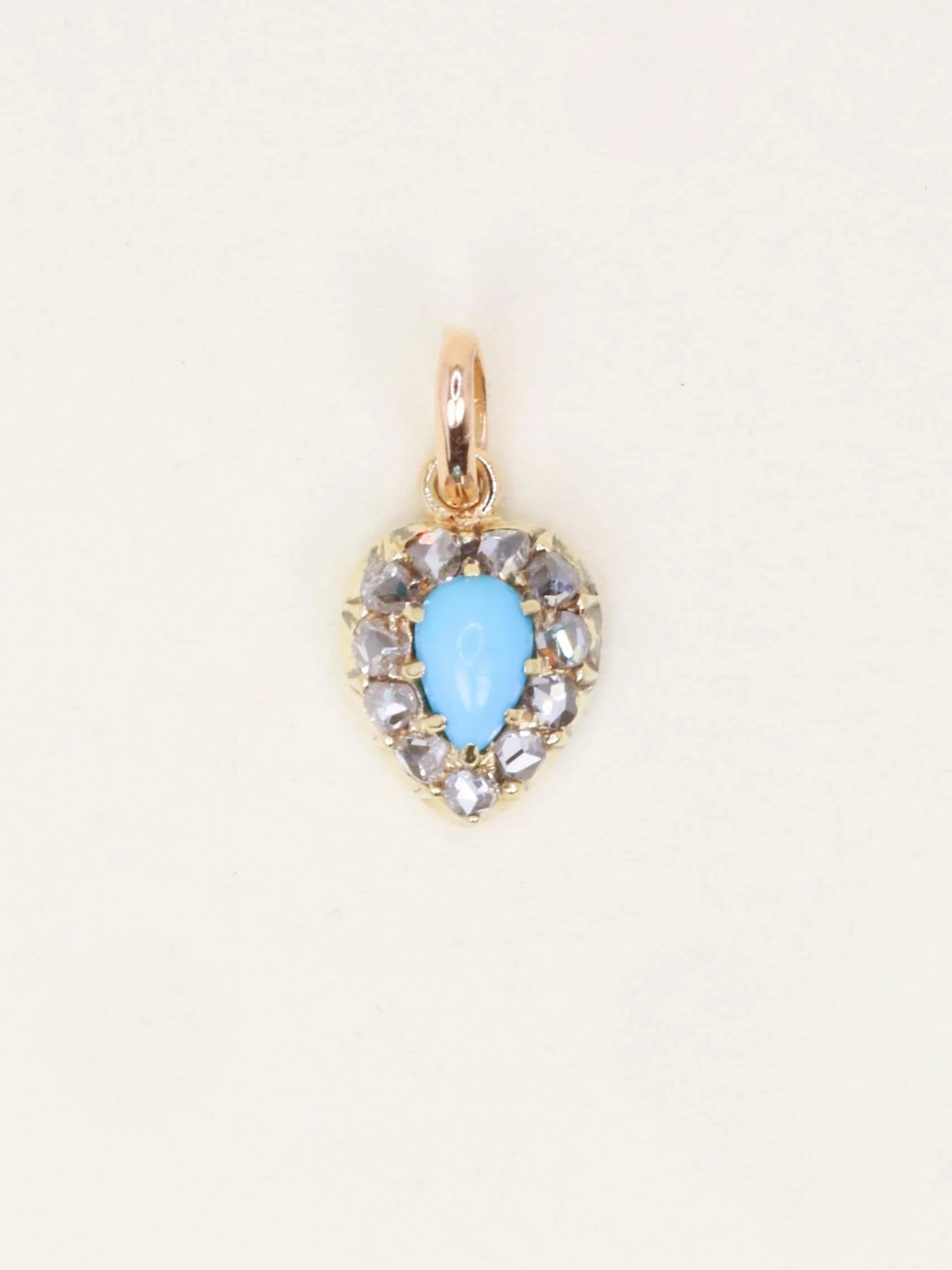
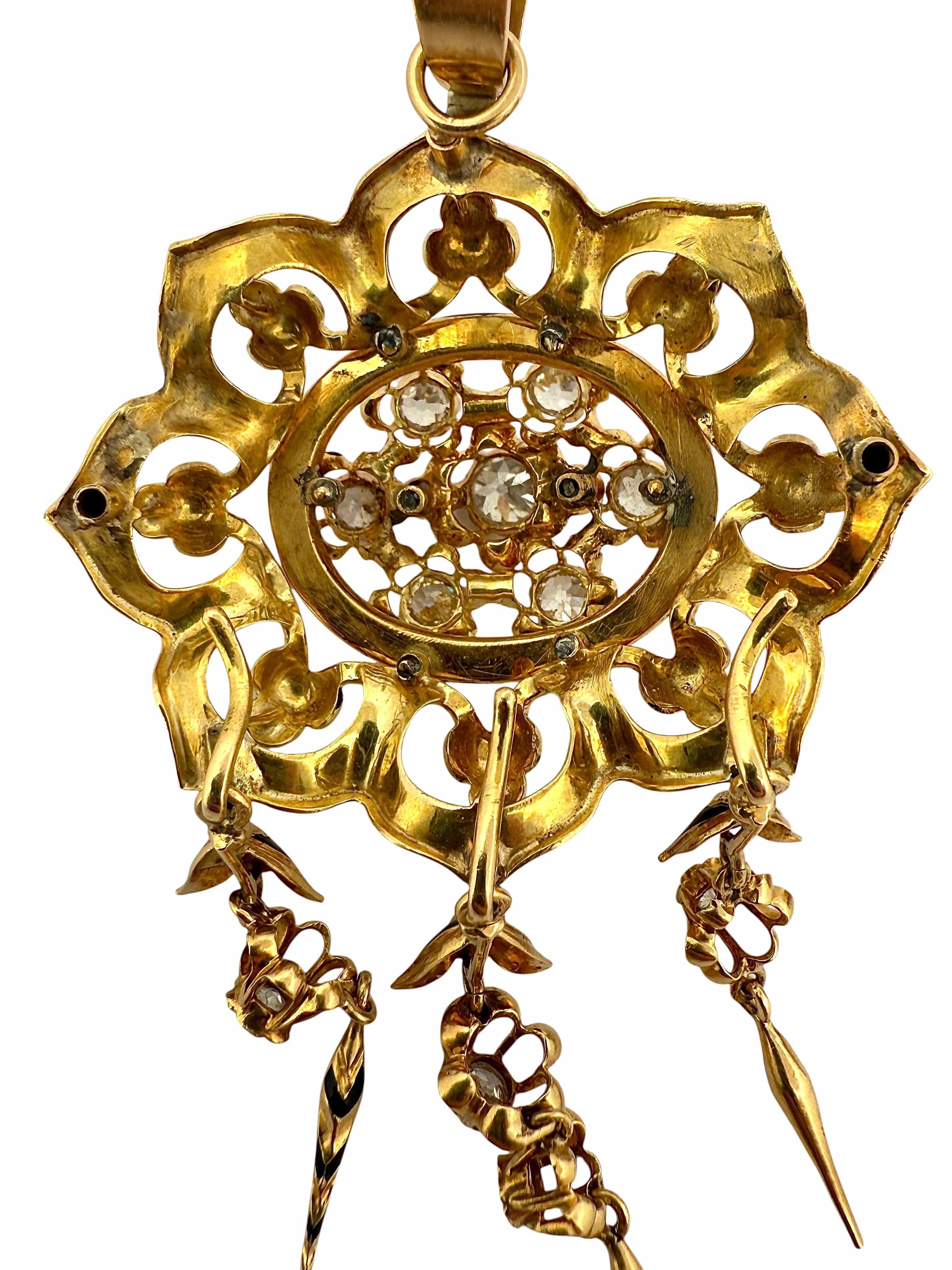
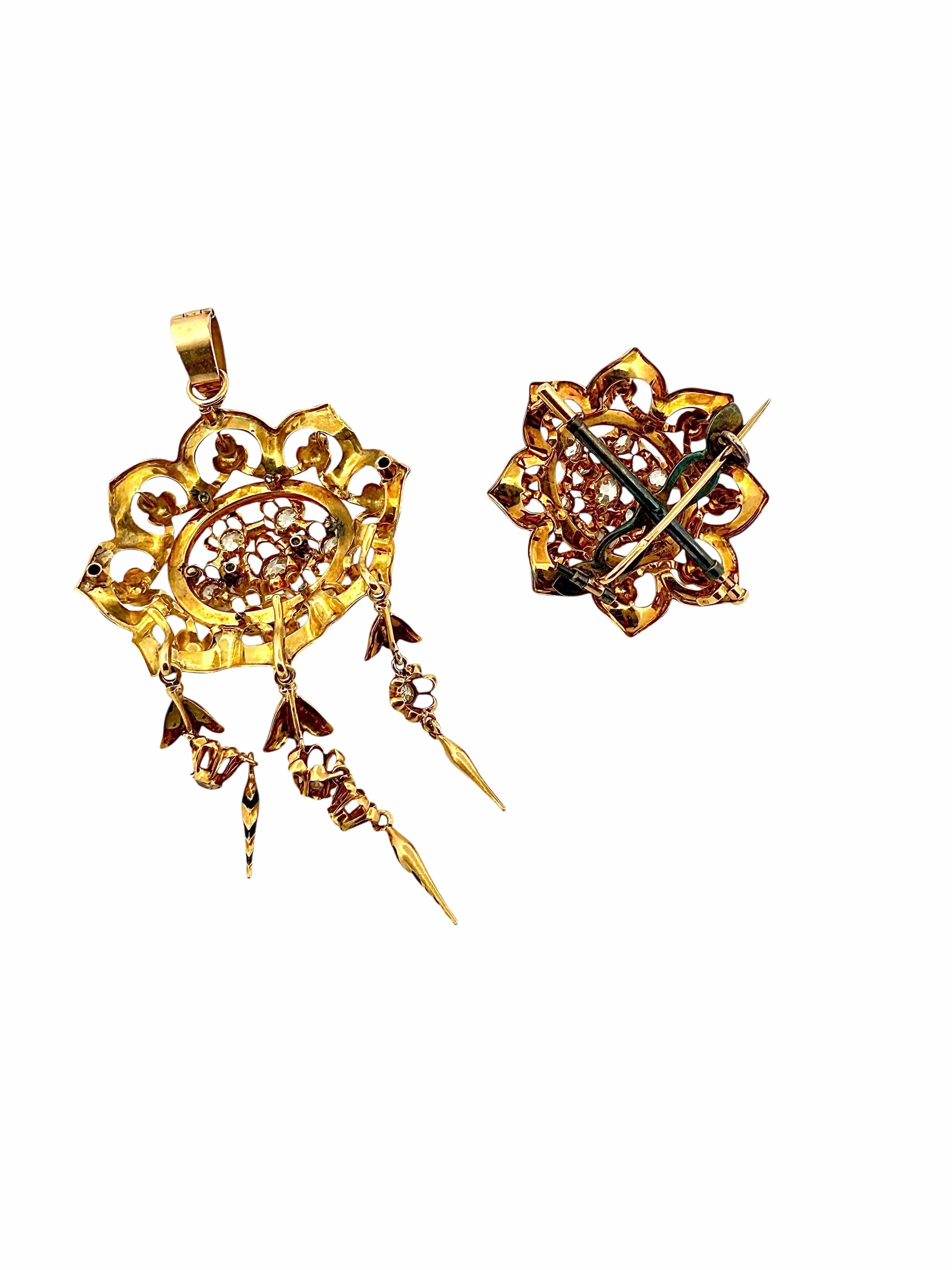
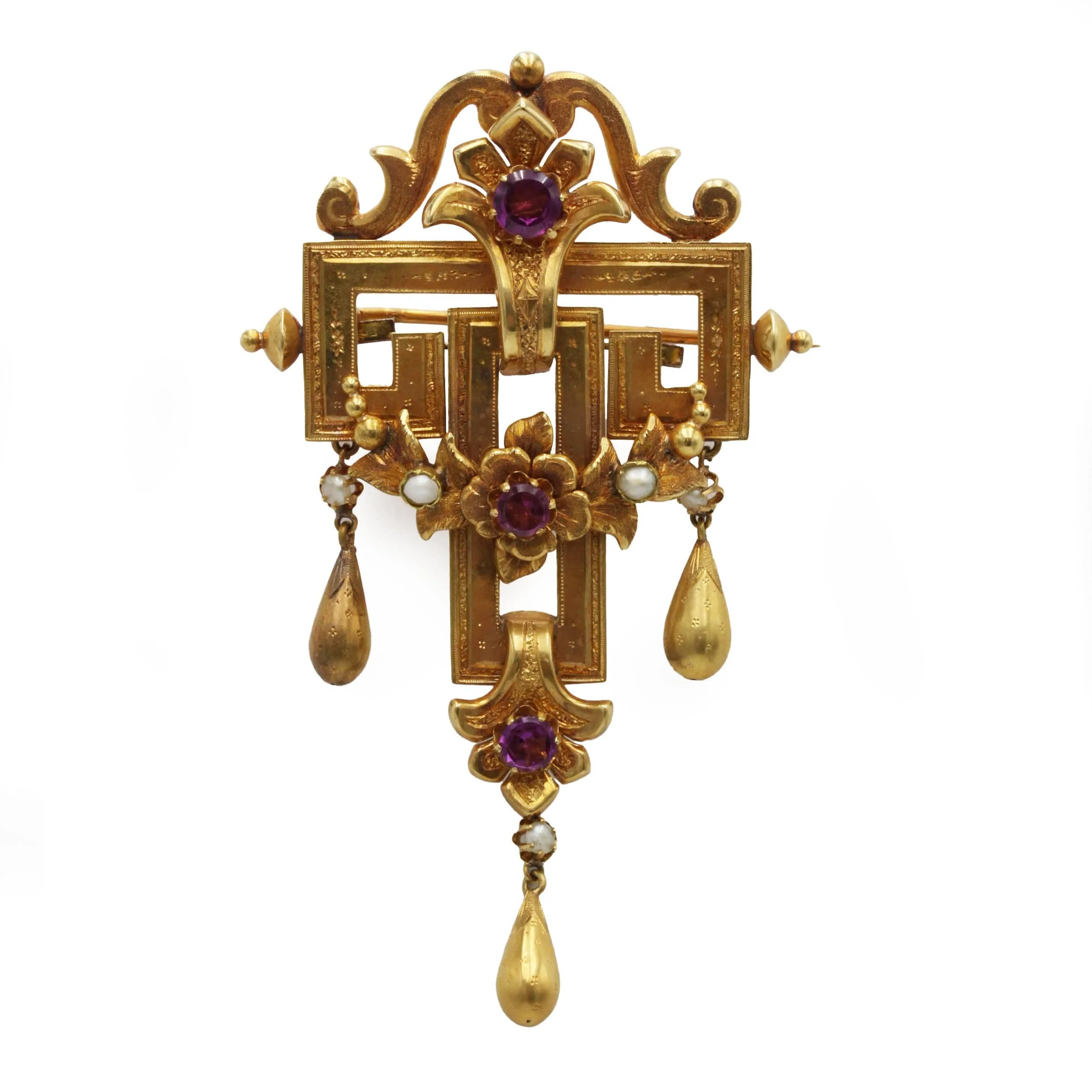
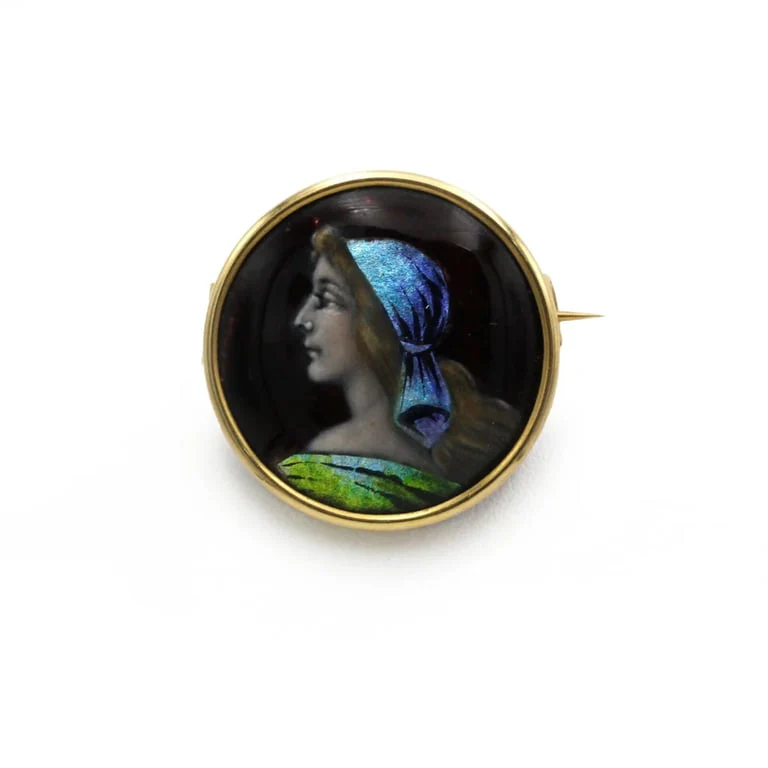
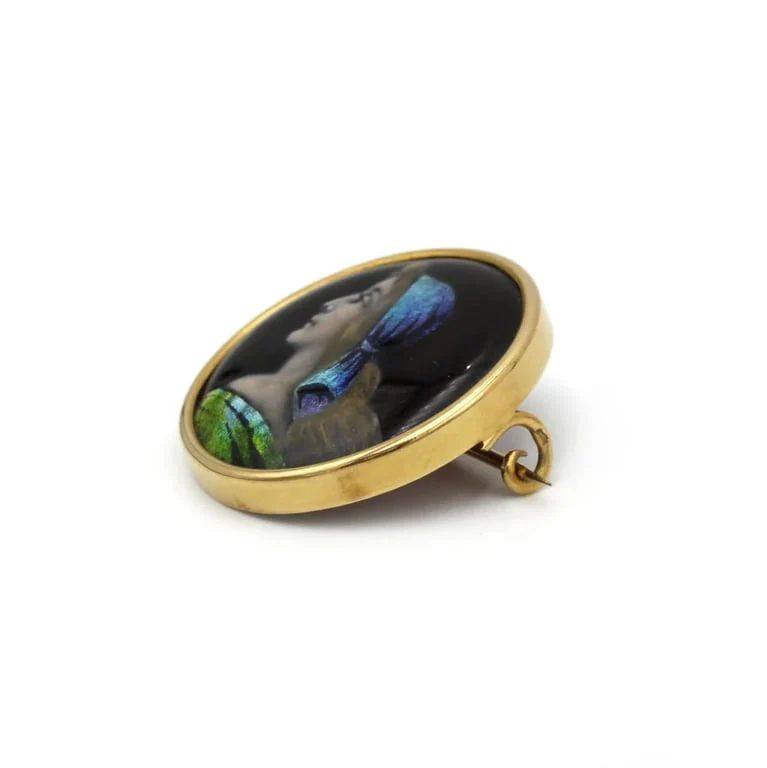
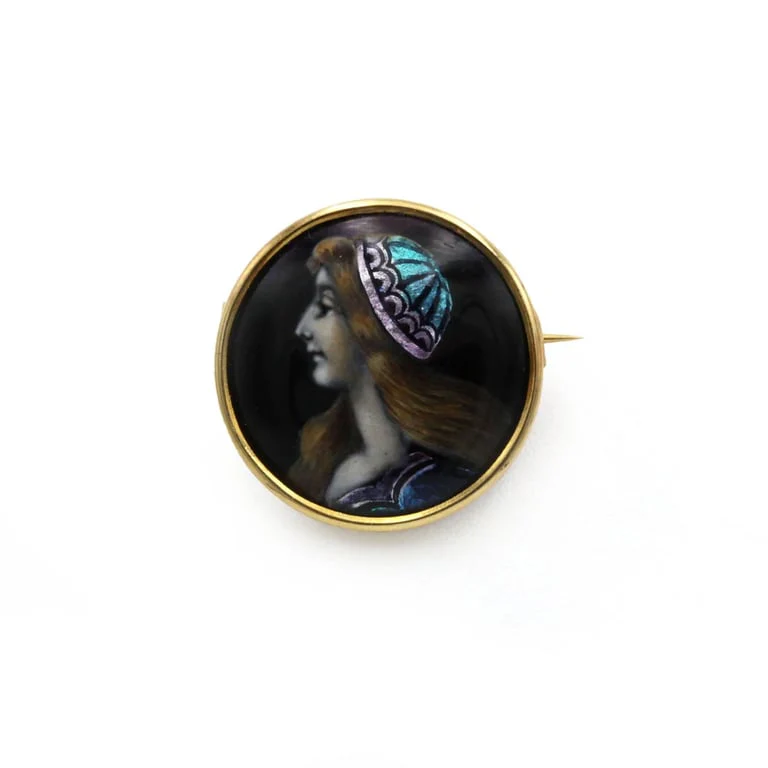
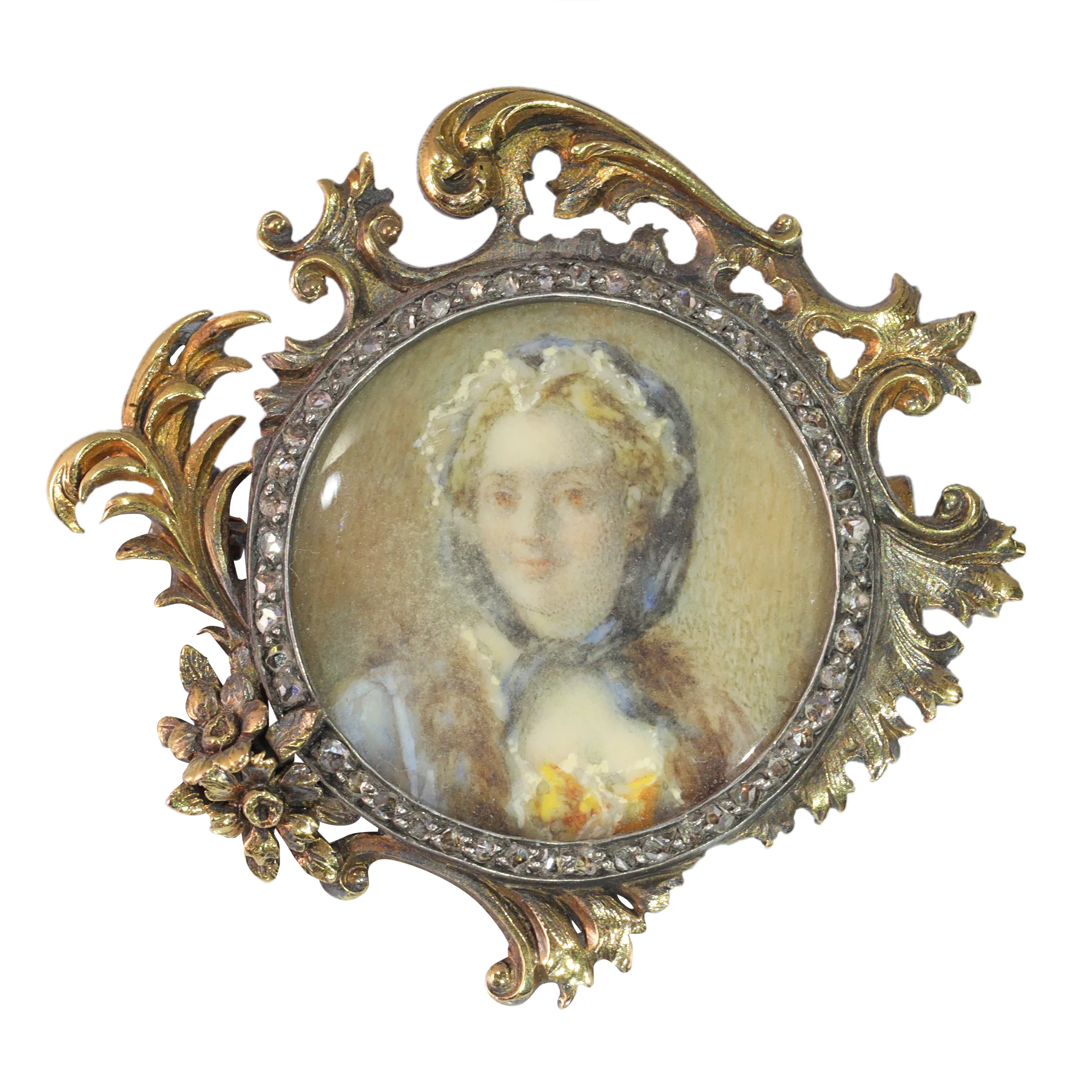
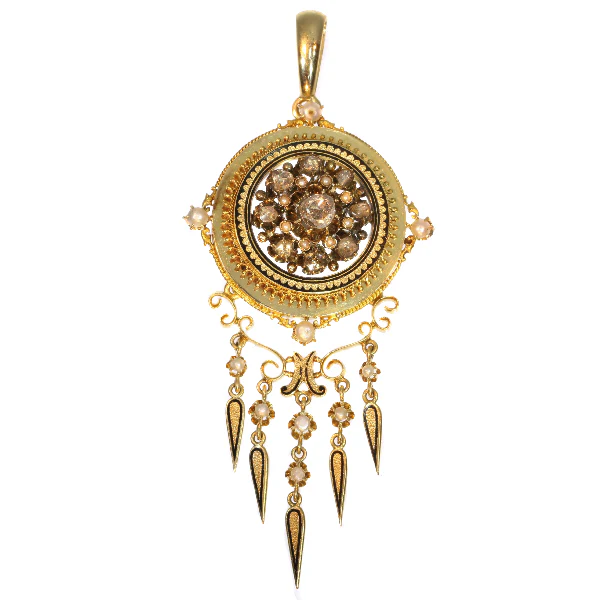
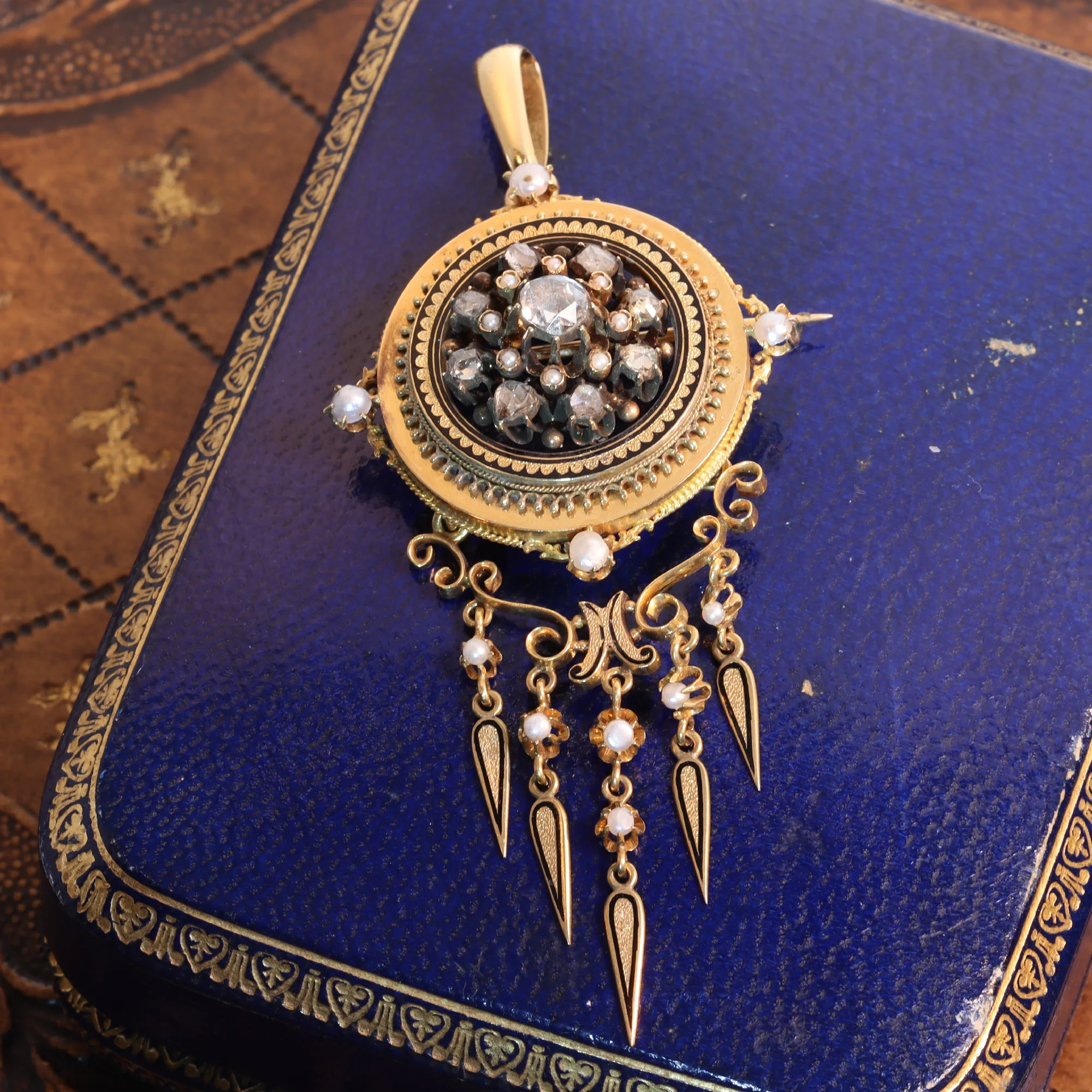
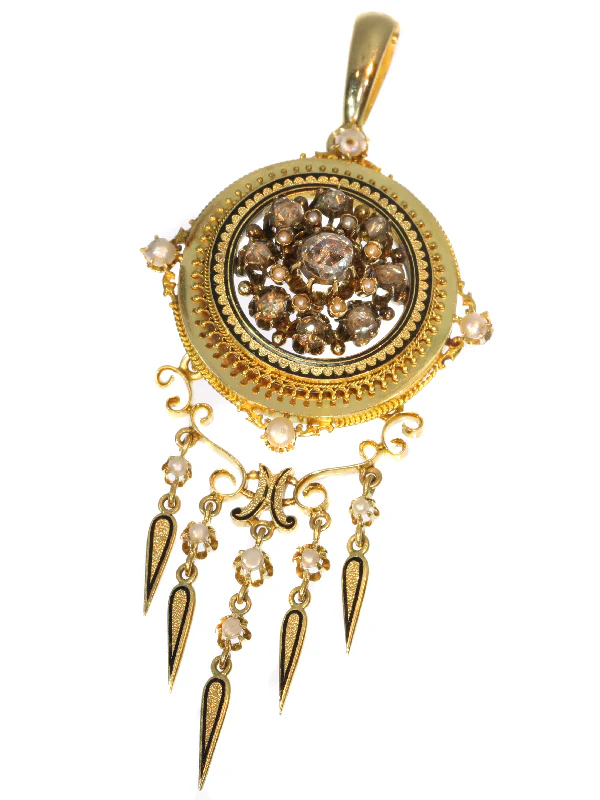
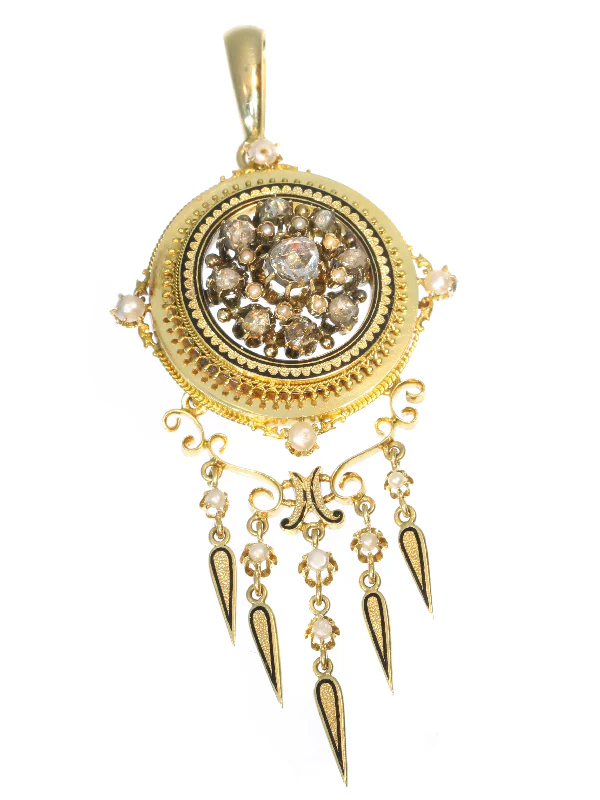
This fascinating brooch-pendant, dating from the Romantic Victorian period around 1860, is a remarkable example of Victorian art. Made of 18-carat yellow gold, this versatile piece is adorned with nine rose-cut diamonds and 18 half seed pearls, embodying the era's love for intricate designs and sentimental motifs. The enameling technique used enhances the jewelry's charm, showcasing craftsmanship that combines beauty and innovation. Adaptable as both a brooch and a pendant, this piece offers a glimpse into the rich history and romantic essence of the Victorian era, making it not only a magnificent accessory but also a piece of wearable history.
Antique jewelry object group:
combined brooch-pendant
Condition:
excellent condition
- (more info on our condition scale)
Country of origin:
Although it bears no legible hallmark, we believe it to be of Belgian origin.
Style:
Victorian - Victorian decorative arts refer to the style of decorative arts during the Victorian era. This period is known for its eclectic revival and reinterpretation of historical styles, as well as the introduction of cross-cultural influences from the Middle East and Asia into furniture, accessories, and interior decoration. Victorian design is widely perceived as having shown a regrettable excess of ornamentation. The Arts and Crafts movement, the aesthetic movement, the Anglo-Japanese style, and Art Nouveau all have their origins at the end of the Victorian era.
- See also: Victorian or more information on styles
Style specifics:
The Romantic Victorian period - Experts divide the reign of Queen Victoria, also called the Victorian era (1837 - 1901), into three periods of about twenty years each: the Romantic Victorian period (1837 - 1860), the Grand Victorian period (1860 - 1880), and the Late or Aesthetic Victorian period (1880 - 1901).
We consider this period to belong to the Romantic Victorian period. This period covers the coronation of Victoria as Queen of Great Britain and Ireland, her marriage to King Albert, their love and devotion to their marriage and country, which were sources of inspiration. The jewelry from this period is made with intricate carvings, special techniques where enamel is subtly worked. These techniques allowed the jewelry to appear opulent with less precious metal. Precious metals were very rare at this time. The most prized (semi-)precious stones at this time were amethyst, coral, garnets, cultured pearls, and turquoise. The connotation is obviously sentimental, symbolic, and romantic, with motifs reminiscent of Gothic and/or Renaissance styles, and abundant use of motifs such as anchors, birds, branches, crosses, hearts, and snakes.
Period:
circa 1860
- (events and facts of this era, poetry of this era, fashion of this era)
Material:
18-carat yellow gold
- (more info on precious metals)
Technique:
Enameling is an ancient and widely used technique. The Egyptians of Antiquity applied enamels to pottery and stone objects. The Greeks, Celts, Russians, and Chinese of Antiquity also used enameling processes on metal objects. Enamel is the colorful result of fusing powdered glass onto a substrate by firing, generally between 750 and 850 °C. The powder melts, flows, and hardens to form a smooth and durable glassy coating on metal, glass, or ceramic. According to some sources, the word enamel comes from the High German smelzan (to melt) via Old French esmail. Used as a noun, “an enamel” refers to a generally small decorative object covered with enamel, such as a champlevé or cloisonné (different techniques). Rose-cut stones are set on foil. This special technique was used to enhance the brilliance of diamonds.
Additional information:
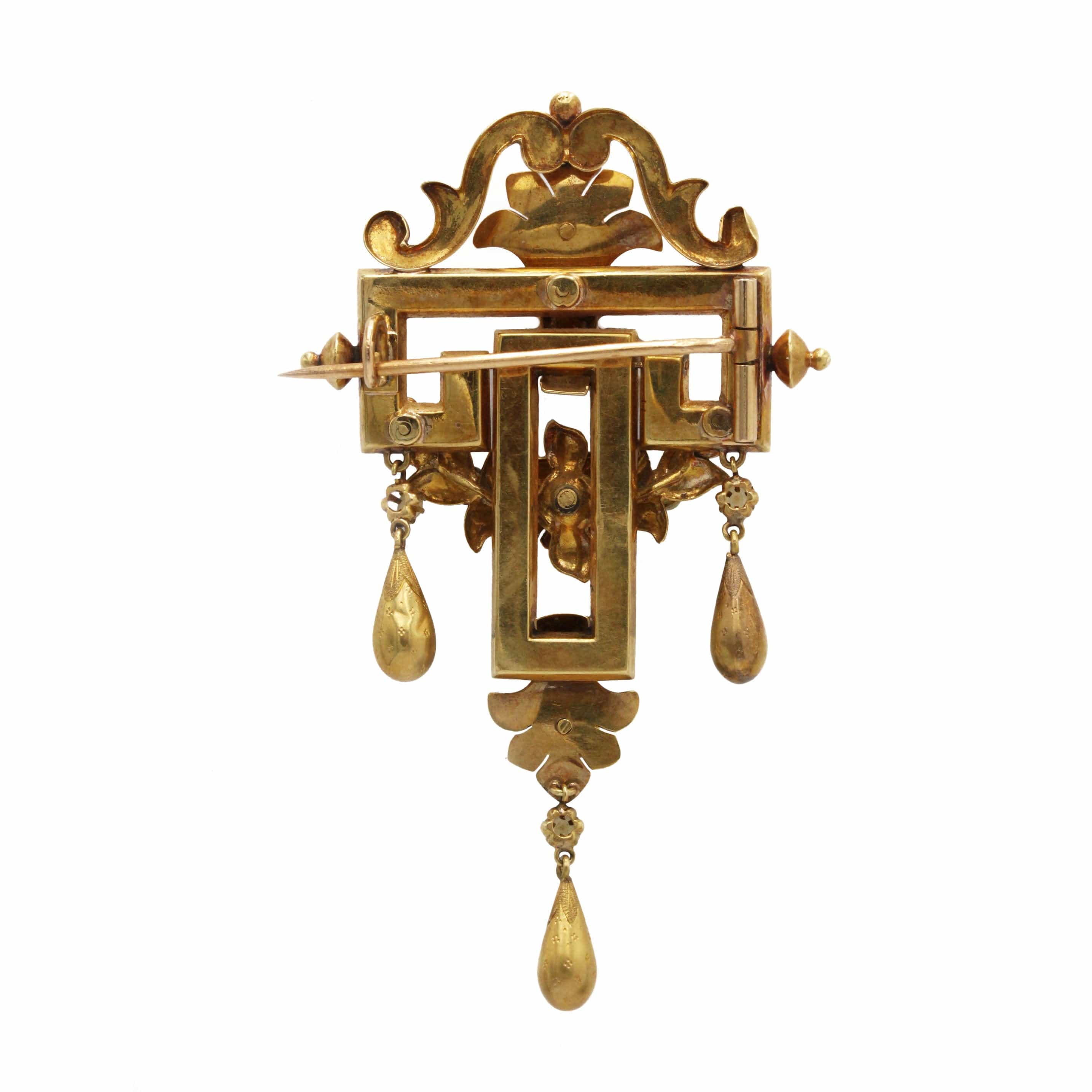
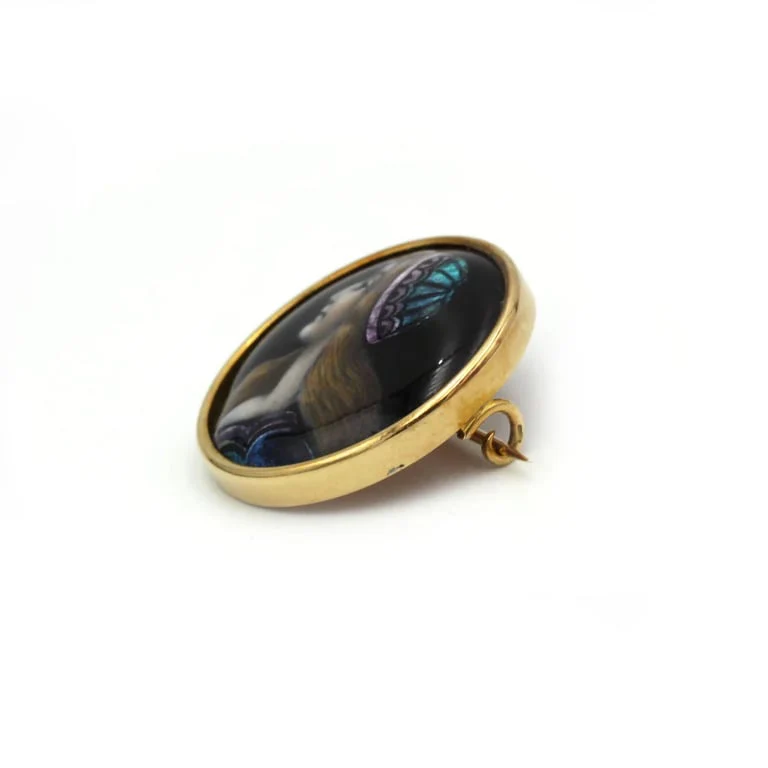
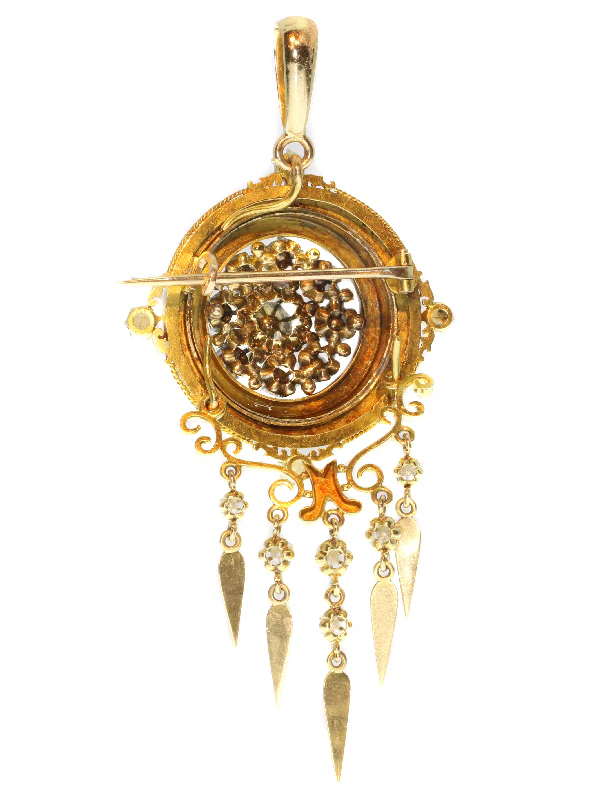
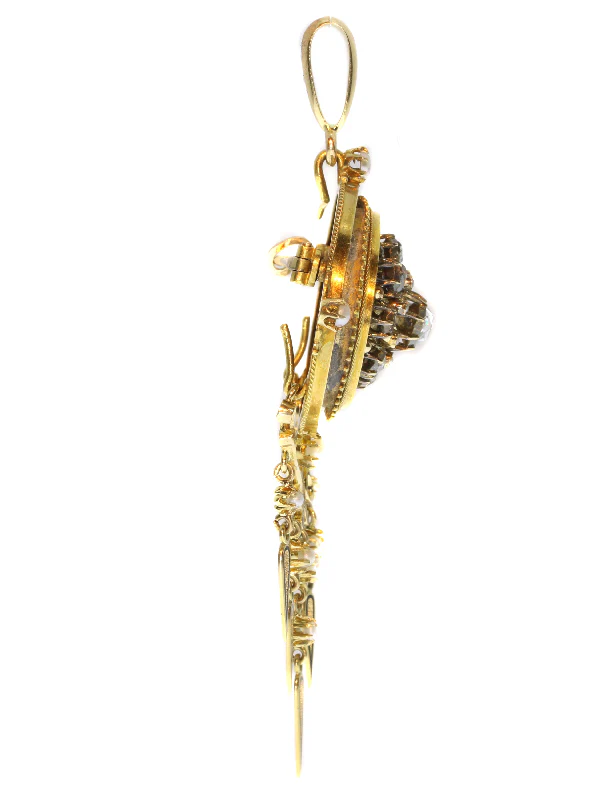
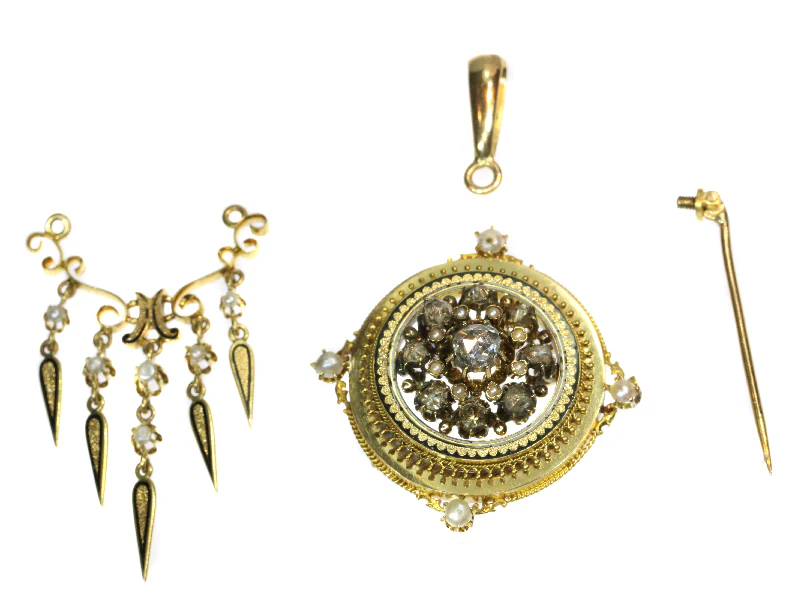
Brooch and pendant – Thanks to a discreet ring system on the back, this piece of jewelry can also be worn as a brooch or pendant. The bail and pin are unscrewable for optimal wear.
Diamond(s):
Nine rose-cut diamonds. We do not know the weight of the diamonds, which is common in our profession for rose-cut diamonds.
Gemstones:
18 half seed pearls
Birthstones:
Diamond is the birthstone (or stone of the month) for April and pearl for June.
- (more information about birthstones)
Hallmarks:
No trace.
- (more information about hallmarks)
Dimensions:
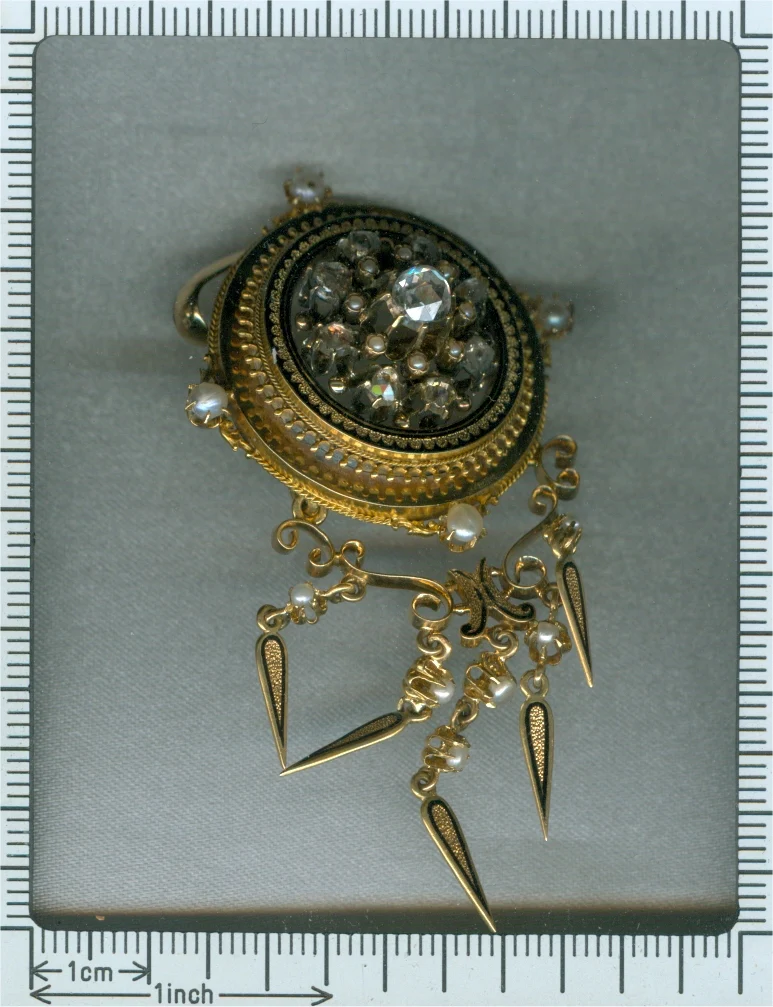
pendant height 9.00 cm (3.54 inches)
Weight:
18.70 grams (12.02 dwt)
More Images
Victorian versatility: the double charm of a brooch-pendant from the 1860s
This fascinating brooch-pendant, dating from the Romantic Victorian period around 1860, is a remarkable example of Victorian art. Made of 18-carat yellow gold, this versatile piece is adorned with nine rose-cut diamonds and 18 half seed pearls, embodying the era's love for intricate designs and sentimental motifs. The enameling technique used enhances the jewelry's charm, showcasing craftsmanship that combines beauty and innovation. Adaptable as both a brooch and a pendant, this piece offers a glimpse into the rich history and romantic essence of the Victorian era, making it not only a magnificent accessory but also a piece of wearable history.
Antique jewelry object group:
combined brooch-pendant
Condition:
excellent condition
- (more info on our condition scale)
Country of origin:
Although it bears no legible hallmark, we believe it to be of Belgian origin.
Style:
Victorian - Victorian decorative arts refer to the style of decorative arts during the Victorian era. This period is known for its eclectic revival and reinterpretation of historical styles, as well as the introduction of cross-cultural influences from the Middle East and Asia into furniture, accessories, and interior decoration. Victorian design is widely perceived as having shown a regrettable excess of ornamentation. The Arts and Crafts movement, the aesthetic movement, the Anglo-Japanese style, and Art Nouveau all have their origins at the end of the Victorian era.
- See also: Victorian or more information on styles
Style specifics:
The Romantic Victorian period - Experts divide the reign of Queen Victoria, also called the Victorian era (1837 - 1901), into three periods of about twenty years each: the Romantic Victorian period (1837 - 1860), the Grand Victorian period (1860 - 1880), and the Late or Aesthetic Victorian period (1880 - 1901).
We consider this period to belong to the Romantic Victorian period. This period covers the coronation of Victoria as Queen of Great Britain and Ireland, her marriage to King Albert, their love and devotion to their marriage and country, which were sources of inspiration. The jewelry from this period is made with intricate carvings, special techniques where enamel is subtly worked. These techniques allowed the jewelry to appear opulent with less precious metal. Precious metals were very rare at this time. The most prized (semi-)precious stones at this time were amethyst, coral, garnets, cultured pearls, and turquoise. The connotation is obviously sentimental, symbolic, and romantic, with motifs reminiscent of Gothic and/or Renaissance styles, and abundant use of motifs such as anchors, birds, branches, crosses, hearts, and snakes.
Period:
circa 1860
- (events and facts of this era, poetry of this era, fashion of this era)
Material:
18-carat yellow gold
- (more info on precious metals)
Technique:
Enameling is an ancient and widely used technique. The Egyptians of Antiquity applied enamels to pottery and stone objects. The Greeks, Celts, Russians, and Chinese of Antiquity also used enameling processes on metal objects. Enamel is the colorful result of fusing powdered glass onto a substrate by firing, generally between 750 and 850 °C. The powder melts, flows, and hardens to form a smooth and durable glassy coating on metal, glass, or ceramic. According to some sources, the word enamel comes from the High German smelzan (to melt) via Old French esmail. Used as a noun, “an enamel” refers to a generally small decorative object covered with enamel, such as a champlevé or cloisonné (different techniques). Rose-cut stones are set on foil. This special technique was used to enhance the brilliance of diamonds.
Additional information:
Brooch and pendant – Thanks to a discreet ring system on the back, this piece of jewelry can also be worn as a brooch or pendant. The bail and pin are unscrewable for optimal wear.
Diamond(s):
Nine rose-cut diamonds. We do not know the weight of the diamonds, which is common in our profession for rose-cut diamonds.
Gemstones:
18 half seed pearls
Birthstones:
Diamond is the birthstone (or stone of the month) for April and pearl for June.
- (more information about birthstones)
Hallmarks:
No trace.
- (more information about hallmarks)
Dimensions:
pendant height 9.00 cm (3.54 inches)
Weight:
18.70 grams (12.02 dwt)
Product Information
Product Information
Shipping & Returns
Shipping & Returns
Description
This fascinating brooch-pendant, dating from the Romantic Victorian period around 1860, is a remarkable example of Victorian art. Made of 18-carat yellow gold, this versatile piece is adorned with nine rose-cut diamonds and 18 half seed pearls, embodying the era's love for intricate designs and sentimental motifs. The enameling technique used enhances the jewelry's charm, showcasing craftsmanship that combines beauty and innovation. Adaptable as both a brooch and a pendant, this piece offers a glimpse into the rich history and romantic essence of the Victorian era, making it not only a magnificent accessory but also a piece of wearable history.
Antique jewelry object group:
combined brooch-pendant
Condition:
excellent condition
- (more info on our condition scale)
Country of origin:
Although it bears no legible hallmark, we believe it to be of Belgian origin.
Style:
Victorian - Victorian decorative arts refer to the style of decorative arts during the Victorian era. This period is known for its eclectic revival and reinterpretation of historical styles, as well as the introduction of cross-cultural influences from the Middle East and Asia into furniture, accessories, and interior decoration. Victorian design is widely perceived as having shown a regrettable excess of ornamentation. The Arts and Crafts movement, the aesthetic movement, the Anglo-Japanese style, and Art Nouveau all have their origins at the end of the Victorian era.
- See also: Victorian or more information on styles
Style specifics:
The Romantic Victorian period - Experts divide the reign of Queen Victoria, also called the Victorian era (1837 - 1901), into three periods of about twenty years each: the Romantic Victorian period (1837 - 1860), the Grand Victorian period (1860 - 1880), and the Late or Aesthetic Victorian period (1880 - 1901).
We consider this period to belong to the Romantic Victorian period. This period covers the coronation of Victoria as Queen of Great Britain and Ireland, her marriage to King Albert, their love and devotion to their marriage and country, which were sources of inspiration. The jewelry from this period is made with intricate carvings, special techniques where enamel is subtly worked. These techniques allowed the jewelry to appear opulent with less precious metal. Precious metals were very rare at this time. The most prized (semi-)precious stones at this time were amethyst, coral, garnets, cultured pearls, and turquoise. The connotation is obviously sentimental, symbolic, and romantic, with motifs reminiscent of Gothic and/or Renaissance styles, and abundant use of motifs such as anchors, birds, branches, crosses, hearts, and snakes.
Period:
circa 1860
- (events and facts of this era, poetry of this era, fashion of this era)
Material:
18-carat yellow gold
- (more info on precious metals)
Technique:
Enameling is an ancient and widely used technique. The Egyptians of Antiquity applied enamels to pottery and stone objects. The Greeks, Celts, Russians, and Chinese of Antiquity also used enameling processes on metal objects. Enamel is the colorful result of fusing powdered glass onto a substrate by firing, generally between 750 and 850 °C. The powder melts, flows, and hardens to form a smooth and durable glassy coating on metal, glass, or ceramic. According to some sources, the word enamel comes from the High German smelzan (to melt) via Old French esmail. Used as a noun, “an enamel” refers to a generally small decorative object covered with enamel, such as a champlevé or cloisonné (different techniques). Rose-cut stones are set on foil. This special technique was used to enhance the brilliance of diamonds.
Additional information:
Brooch and pendant – Thanks to a discreet ring system on the back, this piece of jewelry can also be worn as a brooch or pendant. The bail and pin are unscrewable for optimal wear.
Diamond(s):
Nine rose-cut diamonds. We do not know the weight of the diamonds, which is common in our profession for rose-cut diamonds.
Gemstones:
18 half seed pearls
Birthstones:
Diamond is the birthstone (or stone of the month) for April and pearl for June.
- (more information about birthstones)
Hallmarks:
No trace.
- (more information about hallmarks)
Dimensions:
pendant height 9.00 cm (3.54 inches)
Weight:
18.70 grams (12.02 dwt)